Enhancing Library Collaboration: Innovations in Consortial Electronic Resource Management
130 likes | 238 Vues
This document outlines the evolving landscape of consortial Electronic Resource Management (ERM) in libraries. It discusses the definition of a "consortium," highlighting libraries that share Integrated Library Systems (ILS) or different ILSs while pooling resources. The challenges of integration, perception of complexity, and cost-efficiency are examined. We explore how Innovative Interfaces' new ERM module addresses these hurdles with features like separate user statistics, shared coverage databases, and privacy protocols. The goal is to foster collaboration and improve resource management across member libraries.


Enhancing Library Collaboration: Innovations in Consortial Electronic Resource Management
E N D
Presentation Transcript
New Directions in Consortial ERM • Tom Jacobson • Director of Sales, • Strategic Accounts • Innovative Interfaces, Inc.
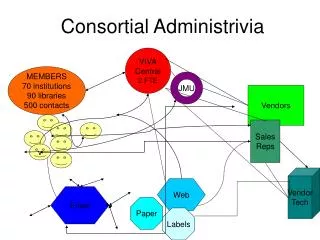
What is meant by “Consortium”? • Libraries with a shared ILS and different resources • Libraries with different ILSs and shared resources • Libraries with different ILSs and different resources
Libraries with different systems New set of challenges … • Libraries may lack history of working together … how to integrate? • Perception that shared system can be complex or too complicated • ERM coverage for all participants • Lowest or most economical cost
Shared ILS or shared Stand-alone ERM but different resources • Innovative ERM module currently provides technical features that support and integrate standard consortium features built-in through Millennium
Consortial ERM must provide for… • Discovery • Privacy • Separate user statistics • Multiple coverage databases
Privacy • Separate staff access for each consortium member • Resource data that is shared, but • License and financial data that is kept private for each consortium member
Coverage database • Unique coverage database for each member • Shared coverage database for shared resources
ERM and WebBridge LR tied together • OpenURL request to include library identifier • Resource data from either library coverage database or consortium coverage database