
Breakthroughs in Nobel Prize-winning Research on Chemistry and Physics
E N D
Presentation Transcript
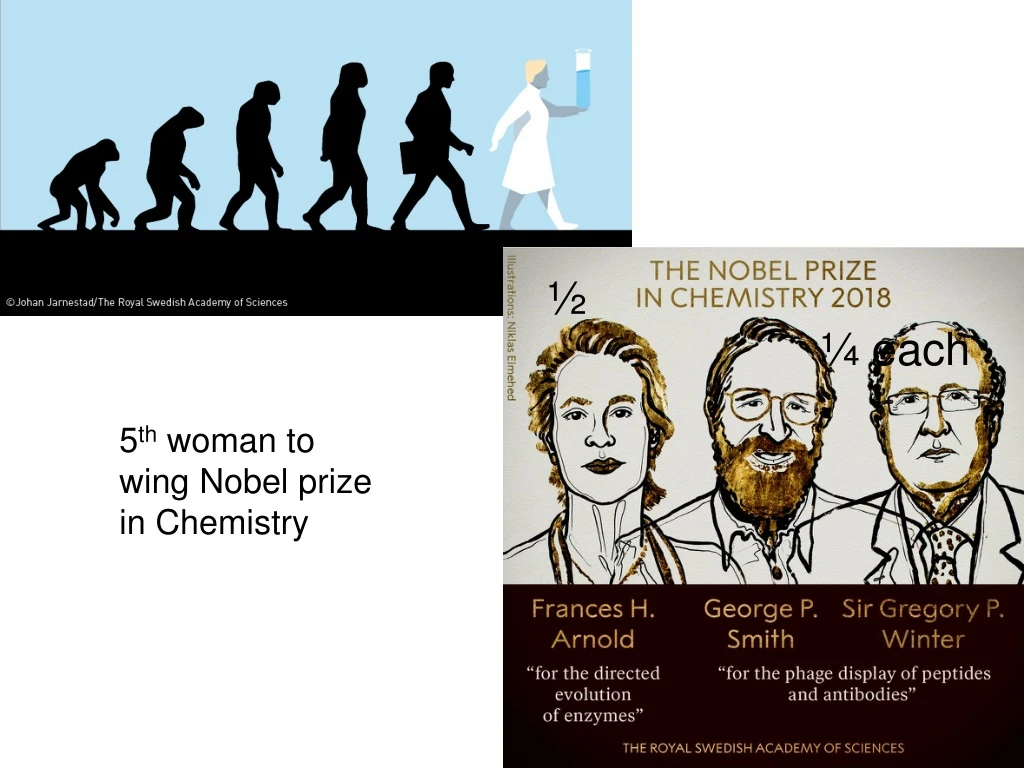
½ ¼ each 5th woman to wing Nobel prize in Chemistry
Frances Arnold More recent work: S. B. Jennifer Kan, Russell D. Lewis, Kai Chen, Frances H. Arnold* Directed evolution of cytochrome c for carbon–silicon bond formation: Bringing silicon to life Science 25 Nov 2016:Vol. 354, Issue 6315, pp. 1048-1051 DOI: 10.1126/science.aah6219
George Smith Building up very large libraries of which gene sequence codes for which capsule protein with which exposed peptide, basis research
Gregory Winter In a sense, application of “directed evolution” to the development of human antibodies (specific proteins) from the antibodies of other mammals by means of George Smith’s phage display technique
Arthur Ashkin ½, Gérard Mourou and Donna Strickland ¼ each 3rd woman to win Nobel prize in Physics
First paper in the field: A. Askin, Phys. Rev. Lett. 24 (1970) 156
It is important that the particles are more or less spherical, the smaller the particles, the faster they move around at any one temperature
Limitation: wavelength of light is several hundreds of nanometers, in the far-field this leads to diffraction limited “confinement radii” of about one half of the wavelength of light
Note the sigmoid function that is approximated over 5 orders of magnitude by a piece-wise exponential function !
Physics Nobel Prize 2018: Gérard Mourou andDonna Strickland ¼ each, for work first demonstrated in 1985 in PhD thesis of DS allows for ultrafast spectroscopy of chemical reactions, ….
10-9 sec 10-15 sec
10-18 sec, a technological development allows to push the science frontier
first Nobel Prize involving optical traps was for laser cooling in 1997, Steven Chu, Claude Cohen-Tannoudji and William D. Phillips, the breakthroughs were made in the 1980s • Room temperature: atoms in a gas move with velocities of about 4,000 km/h • 270 °C: atoms move with velocities of 400 km/hr • 1 µK: atoms move with velocities of 1 km/hr (= 25 cm/s) At the intersection of several laser beams at sufficiently low temperatures, trapped atoms condense into a new state of matter, to be described by a single wavefunstion (a Bose-Einstein condensate) move as if they were within a thick liquid, the name optical molasses was coined.
8 pages, 43 refs. “Single atom loading succeeds approximately half of the time. … Isolated collisions between two atoms do not usually result in molecule formation due to the need to simultaneously conserve momentum and energy. … the atoms can change their hyperfine states after colliding, and the exothermic hyper-fine-spin-changing collisions impart enough kinetic energy (≈ 100 mK) to the atoms to eject them from the tweezers (≈ 1 mK depth).
ℏ reduced Planck constant µ reduced mass, … quantum numbers