Optimization and Scheduling in CSE 331: Understanding Idle Time and Inversions
In this lecture from CSE 331, we explore key concepts essential for effective scheduling and optimization, including definitions of idle time, the "gap" between tasks, and the significance of inversions in scheduling. We review the properties of greedy algorithms that result in schedules with zero idle time and inversions, proving their optimality in achieving a minimum max lateness. Additionally, we discuss strategies for converting optimal schedules into formats with zero inversions. This content is crucial for improving grades and excelling in job interviews.

Optimization and Scheduling in CSE 331: Understanding Idle Time and Inversions
E N D
Presentation Transcript
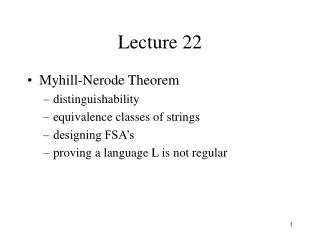
Lecture 22 CSE 331 Oct 26, 2009
Blog posts Please sign up if you have not 32 of you have signed up: 4 lectures with no volunteers If I have a pick a blogger I will only pick ONE/lecture Will lose out on 5% of your grade Nov 6 is now open
How to do better in this class Look up the blog post Helpful for job interviews!
Two definitions for schedules Idle time Max “gap” between two consecutively scheduled tasks Idle time =1 Idle time =0 f=1 Inversion (i,j) is an inversion if i is scheduled before j but di > dj For every i in 1..n do i Schedule job i from si=f to fi=f+ti j f=f+ti j i 0 idle time and 0 inversions for greedy schedule
We proved last lecture Any two schedules with 0 idle time and 0 inversions have the same max lateness
Proving greedy is optimal Any two schedules with 0 idle time and 0 inversions have the same max lateness Greedy schedule has 0 idle time and 0 inversions
Will prove today Any two schedules with 0 idle time and 0 inversions have the same max lateness Greedy schedule has 0 idle time and 0 inversions There is an optimal schedule with 0 idle time and 0 inversions
Optimal schedule with 0 idle time ≥ ≥ = = Lateness “Only” need to convert a 0 idle optimal ordering to one with 0 inversions (and 0 idle time)
Today’s agenda “Exchange” argument to convert an optimal solution into a 0 inversion one Shortest Path problem