Investigating the Equilibrium of the Fe³⁺ + HSCN Reaction Using Beer’s Law and Temperature Dependence
40 likes | 188 Vues
This experiment focuses on understanding the equilibrium constant (K) of the reaction between iron(III) ions (Fe³⁺) and thiocyanate ions (HSCN) to form the iron(III) thiocyanate complex (FeSCN²⁺). Utilizing Beer’s Law, we will create a calibration curve to determine the concentration of FeSCN²⁺ in various solutions. Multiple temperatures will be examined to calculate enthalpy (ΔH), entropy (ΔS), and Gibbs free energy (ΔG) for the reaction. Following proper procedures and employing an ICE table will ensure accurate determination of the equilibrium concentrations.


Investigating the Equilibrium of the Fe³⁺ + HSCN Reaction Using Beer’s Law and Temperature Dependence
E N D
Presentation Transcript
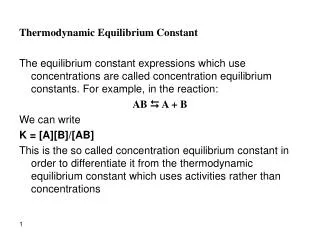
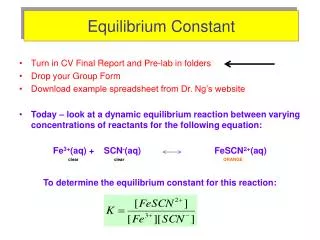
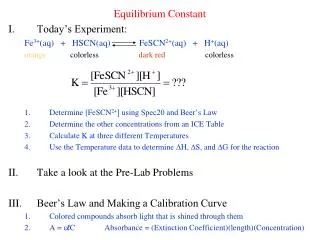
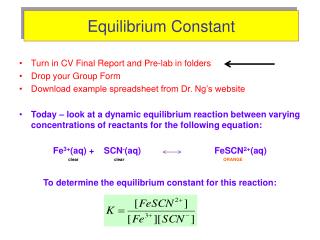
Equilibrium Constant • Today’s Experiment: Fe3+(aq) + HSCN(aq) FeSCN2+(aq) + H+(aq) orange colorless dark red colorless • Determine [FeSCN2+] using Spec20 and Beer’s Law • Determine the other concentrations from an ICE Table • Calculate K at three different Temperatures • Use the Temperature data to determine DH, DS, and DG for the reaction • Take a look at the Pre-Lab Problems • Beer’s Law and Making a Calibration Curve • Colored compounds absorb light that is shined through them • A = elC Absorbance = (Extinction Coefficient)(length)(Concentration)
3. We will use test tubes #1-5 to make a calibration curve using Beer’s Law 4. Excess Fe3+ (0.200 M) pushes the reaction to the right: [HSCN]o = [FeSCN2+] 5. We must use Fe3+ solution as a blank to cancel out Fe3+ absorbance 6. Record %T and calculate A for the five different [HSCN] concentrations 7. Plot A vs. [FeSCN2+] to give a straight line. Calibration Curve 8. Once you find the Absorbance of any other [FeSCN2+] solution, you can find its concentration from the calibration curve. Slope = el A [FeSCN2+]
Procedure for finding K (Tubes #6-9) • Make 4 different solutions of HSCN, Fe3+ • Find A with the Spec20 • Find [FeSCN2+] from the Calibration Curve • Use an ICE Table to find all the other concentrations • All solutions are made with 0.500 M HNO3, so [H+] = 0.500 • Other initial concentrations are found using the Dilution Equation
Slope = -DH/R Intercept = DS/R lnK 1/T V. Procedure for finding DH, DS, and DG (Tubes #6-9 at different T’s) • You will use the same tubes (#6-9) at an ice bath (around 5 oC) • Hot tap water bath temperature (around 45 oC) [Not too hot! Boils off HSCN!) • You already have the room temperature data from these tubes (around 25 oC) • Plot lnK vs. 1/T for your three different temperatures • Use the following equations to calculate DH, DS, and DG for the reaction • Notes: • Use parafilm to cover the test tubes as you mix the solutions thoroughly • Spec20: 0% with nothing in it; 100% with Iron Solution only as Blank • Fill cuvet with most dilute first, rinse with next most dilute, and so on