
Standard XBRL Validation
E N D
Presentation Transcript
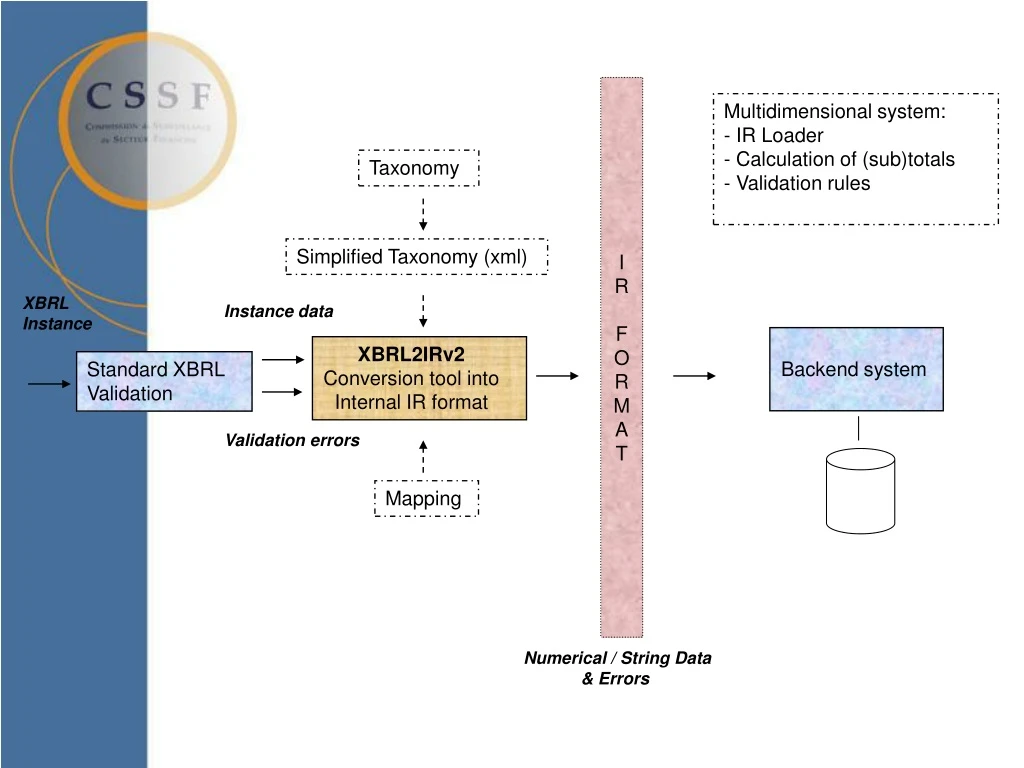
I R F O R M A T • Multidimensional system: • - IR Loader • Calculation of (sub)totals • Validation rules Taxonomy Simplified Taxonomy (xml) XBRL Instance Instance data Backend system XBRL2IRv2 Conversion tool into Internal IR format Standard XBRL Validation Validation errors Mapping Numerical / String Data & Errors
Examples of files used • Mapping file example • Taxonomy component files examples
Backend system • Table structure like TEMPLATES • subtable, row, column, dim1, dim2, … • Multi-dimensional, but with a limited number of free dimensions • Easy-to-use parser for validation rules, including cross-table validation
Approaches (2007 & 2012) • Mapping oriented solution • Ease of maintenance • Reduction of number of european dimensions to a useful number of local dimensions • Re-use of existing multi-dimensional backend-system without a change • XBRL can be treated like « yet another reporting format » alongside with some existing local ones (XML, Excel, Edifact) • Minimal programming in proprietary XBRL APIs • BUT: Taxonomies extended to fit national needs (despite maintenance problems)
Problems & solutions (2007-I) • Local instructions imposed • one single reference reporting period (rather opening balances of period n than closing balances of period n-1) • one single entity per instance • one single consolidation status • one single audit status • XBRL multiple currencies • Checks during instance parsing that the capital currency was the one single currency per instance (« Pure » was allowed for non-monetary items)
Problems & solutions (2007-II) • Calculation linkbase error message readability • Deactivation of XBRL calculation links & re-implementation of formulas via backend system’s validation • Typed dimensions • Request in local instructions to make use of « Typed dimensions » as if they were « Explicit dimensions » i.e. determination of a limited set of authorized values • Corep CRIRB ObligorGrade = « 01 » … « 99 » • Corep MKR SA COM d-ty_Commodity = « Total » • Dimension defaults • Deactivation of Dimension defaults
Goals for 2012 architecture • Enhancement of: • Support of dimension defaults • Dynamic management of typed dimensions • Pre-generation of mapping using the information in the table linkbase
Problems & solutions (2012) - european • Solved problems: • Information rendering (table linkbase) visualisation of instances should be fine • Common european encoding • of technical data cell identifications (existed before) • (p, d1, d2, …dn) • of business cell identifications (to be added) • (t1, r, c, d1, …dn) • Readable error messages using business cell identifications
Problems & solutions (2012) - local • Data of reporting periods T & T-1 in one XBRL instance • map « instant / startDate / endDate » to one dimension of the backend system • The size of some codes of the « Common european encoding » may exceed the size foreseen in the local interface format • a local mapping tables may be required for some codes (at present rows & columns are ok, while table ids exceed local size) • UTF-8 values in typed dimensions • local instructions will impose english transcription of names into ISO-Latin-1
Validation approaches • Doubts on taxonomy validation • No supervision data until fully valid instance delivered • Too small set of formulas necessity for local validation anyway? • Will quality of error messages be fully self-explainable for business users?
Free or commercial validator? • Under investigation • Arelle? (NOFORMULAS) • Market-leading commercial validators? (SOFTFORMULAS, HARDFORMULAS modes)