Understanding the Electromagnetic Spectrum: Frequency, Sound, and Light
This chapter dives into the electromagnetic spectrum, detailing how frequency influences both sound and light. It elucidates the relationship between frequency and pitch—higher frequencies produce higher pitches—while also exploring how different light frequencies correspond to various colors. The chapter categorizes the spectrum into distinct types, including radio waves, microwaves, infrared, visible light, ultraviolet, x-rays, and gamma rays. Each type is characterized by its wavelength, frequency, and energy, emphasizing the importance of understanding these concepts in everyday life, from communication to health.

Understanding the Electromagnetic Spectrum: Frequency, Sound, and Light
E N D
Presentation Transcript
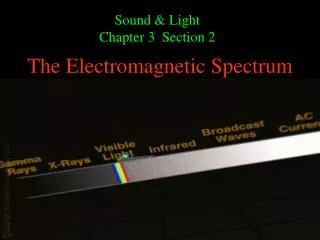
Sound & LightChapter 3 Section 2 The Electromagnetic Spectrum
How does frequency affect sound? • Higher f = higher pitch How do you think frequency affects light? • Different frequencies are different colors
I. Electromagnetic Spectrum • All waves travel at the same speed 1. Different wavelengths 2. Different frequencies
II. Types • Radio waves 1. Long λ , Low f 2. Low energy 3. AM – Amplitude modulation a. Travel farther 4. FM – Frequency modulation a. Encodes more information 5. TV
B. Microwaves • More energy than radio • Ovens • Radar (Radio Detection And Ranging) a. Similar to SONAR
C. Infrared Waves • Energy from sun that heats your skin • Infrared binoculars
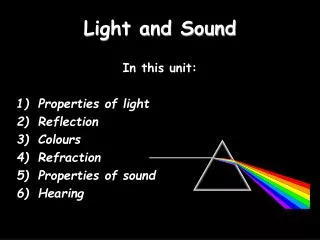
D. Visible Light • See wavelengths as color a. Longest = red b. Shortest = violet (most energy) 2. Visible spectrum a. ROY G. BIV b. All together = white
E. Ultraviolet • Shorter λ = higher energy a. Kills bacteria b. Helps skin cells produce vitamin D 2. Protection a. Causes sunburn, cancer, etc. b. SPF sunscreen (Sun Protection Factor) c. Sunglasses
F. X-rays & Gamma rays • Large energy = penetrating power a. Too much exposure may damage or kill cells b. Radiation treatments