
SlideServe
Menu
Préférences
© SlideServe · v2026

Promoting High, Inclusive, and Sustainable Development in the New Normal

burke-garner avatar
14 diapositives · 239 Views · Nov 27, 2014

Explore the challenges and opportunities for countries in transitioning to high income levels through sustainable and inclusive growth strategies. Learn about the importance of competition policy and investment regimes in driving economic development.
Promoting High, Inclusive, and Sustainable Development in the New Normal - slide 1
01 / 14Promoting High, Inclusive, and Sustainable Development in the New Normal
1 / 17

Télécharger la présentation

Promoting High, Inclusive, and Sustainable Development in the New Normal
Une image / un lien ci-dessous est fourni (tel quel) pour télécharger la présentation

Politique de téléchargement : le contenu du site vous est fourni TEL QUEL pour votre information et votre usage personnel ; il ne peut être vendu, concédé sous licence ni partagé sur d’autres sites sans l’accord de son auteur.Le contenu vous est fourni TEL QUEL, pour votre information et votre usage personnel uniquement. Téléchargez la présentation en cliquant sur ce lien. Lors du téléchargement, si vous ne parvenez pas à télécharger une présentation, l’éditeur a peut-être supprimé le fichier de son serveur.Pendant le téléchargement, si vous ne parvenez pas à obtenir une présentation, le fichier a peut-être été supprimé par l’éditeur.

F I N

Plus de contenu associé

Transcription de la présentation
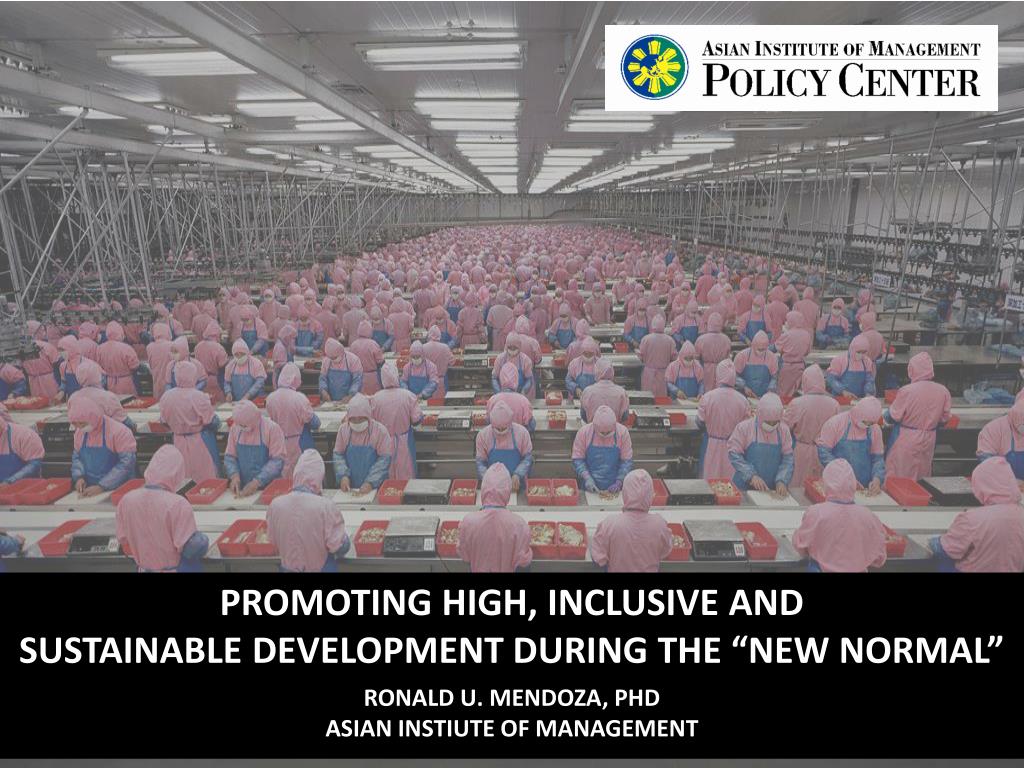
  1. PROMOTING HIGH, INCLUSIVE AND SUSTAINABLE DEVELOPMENT DURING THE “NEW NORMAL” RONALD U. MENDOZA, PHD ASIAN INSTIUTE OF MANAGEMENT

  2. If the era of high global growth is over, then are more countries going to be “trapped” in slow growth? Total Number of Years to Graduate from Lower Middle Income to Upper Middle Income Group

  3. If the era of high global growth is over, then are more countries going to be “trapped” in slow growth? Total Number of Years to Graduate from Upper Middle Income to High Income Group

  4. Growth produced higher or lower inequality? Flip a coin… Real GDP Growth Rate (Average) and Percent Change in Gini Coefficient (Average)

  5. Moving the goal post? From simply “rapid growth” To….High, Sustainable and Inclusive Growth

  6. Structural Transformation from Resource-Based, to Efficiency-Based to Innovation-Based Economies Source: WEF (2013:11).

  7. Institutions underpin the catch-up on the final stage…

  8. Continuing economic integration will be critical but challenging… “ASEAN Economic Community: Status of Implementation, Challenges and Bottlenecks” (CARI, 2013) Investment Regimes --Weak progress: So far, progress focused on sharing and disseminating information on investment policies and opportunities; over-all liberalization of investments not in pace with the liberalization of goods trade; absence of transparent dispute settlement mechanisms Source: CIMB ASEAN Research Institute (http://www.cariasean.org/)

  9. ASEAN 2015: Are we ready? Competition Policy Regulator is like a Referee in a Market Economy – the game has begun even without a clear referee… COUNTRIES WITH COMPETITION POLICY LAWS: Indonesia (Competition Act of 1999); Malaysia (Competition Act of 2010); Singapore (Singapore Competition Act of 2004); Thailand (Trade Competition Act of 1999); Vietnam (Law of Competition 2005) COUNTRIES WITH NO GENERIC COMPETITION LAWS: Brunei (Monopolies Act 1932; but no generic competition laws); Cambodia; Laos; Myanmar; Philippines (no generic competition laws with scattered industry-based laws with own enforcement agencies); Source: CIMB ASEAN Research Institute (http://www.cariasean.org/)

  10. ASEAN 2015: Are we ready? Competition Policy --Some (but uneven) progress: development of the ASEAN Regional Guidelines on Competition Policy; ASEAN is far from creating a level playing field for companies in the form of a harmonized regional competition regime. Source: CIMB ASEAN Research Institute (http://www.cariasean.org/)

  11. Internal markets gaining ground?

  12. Domestic consumption could be strengthened by better management of risk…

  13. Key challenges to help mitigate the risk of a MIT… • Boost human capital investments and enlarge the middle class • Strengthen public-private partnerships and build stronger inclusiveness, notably for SMEs • Strengthen domestic institutions to promote fair competition • Promote crisis resilience and invest in R&D