Innovative Approaches in Ptolemy: Structural Reconfigurable Hardware Design and Synthesis
This paper explores the challenges and solutions in contemporary hardware design, focusing on Ptolemy II as a versatile platform for reconfigurable and heterogeneous hardware systems. It highlights the importance of aspects like concurrency, modular design, mixed-signal systems, and low-power solutions. By leveraging Ptolemy’s strengths in component-based frameworks and diverse computation models, designers can address complexities in ASIC development, facilitating higher productivity and efficiency in both design and verification processes. The work emphasizes collaboration and experimentation as vital for advancing hardware design methodologies.

Innovative Approaches in Ptolemy: Structural Reconfigurable Hardware Design and Synthesis
E N D
Presentation Transcript
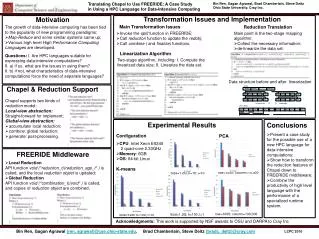
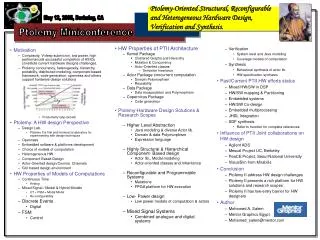
Ptolemy-Oriented Structural, Reconfigurable and Heterogeneous Hardware Design, Verification and Synthesis. • Motivation • Complexity, V-deep submicron, low power, high performance& successful completion of ASICs constitute current hardware designs challenges. • Ptolemy concurrency, heterogeneity, hierarchy, portability, distributed modeling, component-based framework, code generation, openness and otherssupport hardware design solutions • Productivity Gap Growth • Ptolemy: A HW design Perspective • Design Lab. • Ptolemy II is first and foremost a laboratory for experimenting with design techniques • Openness • Embedded software & platforms development • Choice of models of computation • Heterogeneous HW • Component Based Design • Actor-Oriented design/Comms. Channels • GUI based design environment • HW Properties of Models of Computations • Continuous Time • Analog • Mixed Signal / Modal & Hybrid Models • CT + FSM = Modal Model • Re-configurability • Discrete Events • Digital • FSM • Control • HW Properties of PTII Architecture • Kernel Package • Clustered Graphs and Hierarchy • Mutation & Concurrency • Actor-Oriented classes • Derivation Invariance • Actor Package concurrent computation • Domain Polymorphism • Reusability • Data Package • Data encapsulation and Polymorphism • Copernicus Package • Code generation • Ptolemy-Hardware Design Solutions & Research Scopes • Higher Level Abstraction • Java modeling & diverse Actor lib. • Domain & data Polymorphism • Expression language • Highly Structural & Hierarchical Component- Based design • Actor lib., Modal modeling • Actor-oriented classes and inheritance • Reconfigurable and Programmable Systems • Mutations • FPGA platform for HW execution • Low- Power design • Low power models of computation & actors • Mixed Signal Systems • Combined analogue and digital systems • Verification • System level and Java modeling • Coverage models of computation • Synthesis • Behavioral synthesis of actor lib. • HW specification synthesis • Past/Current PTII HW efforts status • Mixed HW/SW in DSP • HW/SW mapping & Partitioning • Embedded systems • HW/SW Co-design • Embedded multiprocessing • JHDL Integration • SDF synthesis • Refer to handout for complete references • Influence of PTII Joint collaborations on HW design • Agilent ADS • Mescal Project UC, Berkeley • PeaCE Project, Seoul National University • VisualSim from Mirabilis • Conclusion • Ptolemy II address HW design challenges • Ptolemy II presents a rich platform for HW solutions and research scopes • Ptolemy II has low-entry barrier for HW designers • Author • Mohamed A. Salem • Mentor Graphics Egypt • Mohamed_salem@mentor.com