Download
1 / 19
190 likes | 311 Vues
This section explores the fundamental concept of chemical bonding, defined as the attractive force between atoms in a compound. It covers the three primary types of bonding: metallic, ionic, and covalent. You'll learn about Lewis symbols and dot diagrams, which illustrate valence electrons and stability. Additionally, the section discusses the transfer of electrons in ionic bonding, the sharing of electron pairs in covalent bonding, and how electronegativity determines bond types. Troubleshooting practice problems help reinforce understanding.

E N D
Chemical Bonding Chapter 8 Section 1
A chemical bond is: a force of attraction between any two atoms in a compound. • Bonding between atoms occurs because it creates a more stable arrangement for the atoms.
Lewis Symbols – Dot Diagrams • Convenient way to show the valence electrons
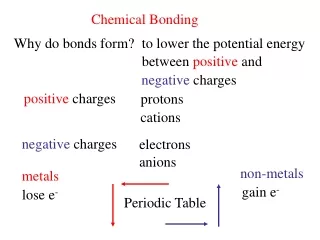
Three types of bonding • Metallic bonding – results from the attraction between metal atoms and the surrounding sea of electrons • Ionic bonding – results from the electrical attraction between large numbers of cations and anions • Covalent bonding – results from the sharing of electron pairs between two atoms
Ionic Bonding • Many atoms transfer electrons and other atoms accept electrons, creating cations (positive metal ions) and anions (negative nonmetal ions). • The resulting ions are attracted to each other by electrostatic force.
Covalent bonding • In many cases electrons do not completely transfer from one atom to another. • The electrons between atoms are shared.
Covalent bonding between H2 • Hydrogen’s electron configuration is 1s1 • Because both H atoms need 1 more electron to become isoelectronic with He, it is unlikely that either will give up an electron.
Covalent bonding between H2 ↑ 1s ↓ 1s They share the two electrons. H· + H · H : H
Types of Covalent Bonds • When electrons are shared equally the bond is called a NONPOLAR covalent bond. (i.e. H2) • Sometimes the electrons between two atoms are NOT shared equally. The bond created is called a POLAR covalent bond. . . . . H· + ·Cl: H:Cl: . . . .
Polar Covalent Bonding • An example of this would be HCl. HCl molecule Hydrogen atom ↑ 1s [Ne] ↑↓↑↓↑↓ ↓ 3s 3p Chlorine atom
How to classify bond types • Electronegativity – measure of the ability of an atom to attract electrons in a chemical bond • Each element on the periodic table is assigned an electronegativity value (see page 353) that ranges from 0.7 to 4.0. • The difference in the electronegativity determines the bonding type (ionic, polar covalent, or nonpolar covalent).
If the electronegativity difference is: 1.7 and higher ionic 0.3 to 1.7 polar covalent 0.0 to 0.3 nonpolar covalent
What if I get an electronegativity difference that is 0.3 or 1.7? • These cut-off numbers are guidelines. • It is a gradual change not stair-step.
Practice Problems What type of bond will occur between iodine and the following elements: cesium, iron, and sulfur?