
Lecture Presentation
E N D
Presentation Transcript
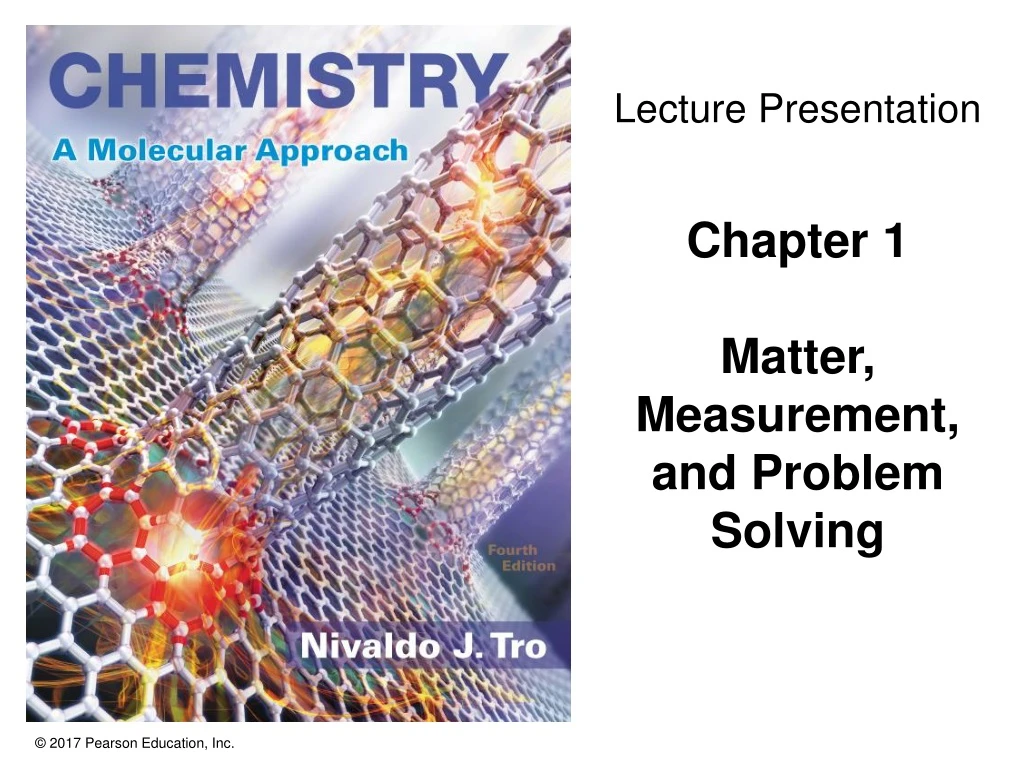
Lecture Presentation Chapter 1Matter, Measurement, and Problem Solving
What Do You Think? • What do you think is the most important idea in all of human knowledge? • If we limit ourselves only to scientific answers, it would be this: • The properties of matter are determined by the properties of molecules and atoms.
Atoms and Molecules • Atoms and molecules determine how matter behaves; if they were different, matter would be different. • The properties of water molecules determine how water behaves; the properties of sugar molecules determine how sugar behaves. • The understanding of matter at the molecular level gives us unprecedented control over that matter.
Atoms and Molecules • Atoms are the submicroscopic particles that constitute the fundamental building blocks of ordinary matter. • Free atoms are rare in nature; instead they bind together in specific geometrical arrangements to form molecules.
Atoms and Molecules • Liquid water is composed of water molecules. • Each molecule contains two hydrogen atoms and an oxygen atom held together by a chemical bond.
Atoms and Molecules • If we want to understand the substances around us, we must understand the atoms and molecules that compose them—this is the central goal of chemistry. • Chemistry is the science that seeks to understand the behavior of matter by studying the behavior of atoms and molecules.
Atoms and Molecules • Small differences in atoms and molecules can result in large differences in the substances that they compose. • Graphite and diamond are both made of carbon. • The atoms in graphite are arranged in sheets. By contrast, the carbon atoms in diamond are all bound together in a three-dimensional structure.
The Scientific Approach to Knowledge • The approach to scientific knowledge is empirical—it is based on observationand experiment. • The scientific method is a process for understanding nature by observing nature and its behavior, and by conducting experiments to test our ideas. • Key characteristics of the scientific method include observation, formulation of hypotheses, experimentation, and formulation of lawsandtheories.
Observations • Observations are also known as data. • They are the descriptions about the characteristics or behavior of nature. • Antoine Lavoisier (1743–1794) noticed that there was no change in the total mass of material within the container during combustion. • Observations often lead scientists to formulate a hypothesis.
Hypothesis • A hypothesis is a tentative interpretation or explanation of the observations. • For example, Lavoisier explained his observations on combustion by hypothesizing that when a substance burns, it combines with a component of air. • A good hypothesis is falsifiable. • The results of an experiment may support a hypothesis or prove it wrong, in which case the scientist must modify or discard the hypothesis.
A Scientific Law • A brief statement that summarizes past observations and predicts future ones. • Law of conservation of mass—“In a chemical reaction, matter is neither created nor destroyed.” • Allows you to predict future observations. • So you can test the law with experiments • Unlike civil or governmental laws, you cannot choose to violate a scientific law.
Theory • One or more well-established hypotheses may form the basis for a scientific theory. • A scientific theory is a model for the way nature is and tries to explain not merely what nature does, but why. • Theories are validated by experiments. • Theories can never be conclusively proven because some new observation or experiment always has the potential to reveal a flaw.
Theory • General explanation for the characteristics and behavior of nature • Models of nature • Dalton’s atomic theory • Can be used to predict future observations • So they can be tested by experiments
Conceptual Connection 1.1 Which statement best explains the difference between a law and a theory? (a) A law is truth; a theory is a mere speculation. • A law summarizes a series of related observations;a theory gives the underlying reasons for them. (c) A theory describes what nature does; a law describes why nature does it.
Conceptual Connection 1.1 Which statement best explains the difference between a law and a theory? • A law is truth; a theory is a mere speculation. • A law summarizes a series of related observations; a theory gives the underlying reasons for them. • A theory describes what nature does; a law describes why nature does it.
The Classification of Matter • Matter is anything that occupies space and has mass. • Your textbook, your desk, your chair, and even your body are all composed of matter. • We can classify matter according to its state (its physical form) and its composition (the basic components that make it up).
The States of Matter • Matter can be classified as solid, liquid, or gas based on what properties it exhibits. • The state of matter changes from solid to liquid to gas with increasing temperature.
Structure Determines Properties • The atoms or molecules have different structures in solids, liquids, and gases—leading to different properties.
Solid Matter • In solid matter, atoms or molecules pack close to each other in fixed locations. • Although the atoms and molecules in a solid vibrate, they do not move around or past each other. • Consequently, a solid has a fixed volume and rigid shape. • Ice, aluminum, and diamond are examples of solids.
Solid Matter • Solid matter may be crystalline, in which case its atoms or molecules are in patterns with long-range, repeating order. • Table salt and diamond are examples of crystalline solid matter. • Others may be amorphous, in which case their atoms or molecules do not have any long-range order. • Glass and plastic are examples of amorphous solids.
Liquid Matter • In liquid matter, atoms or molecules pack about as closely as they do in solid matter, but they are free to move relative to each other. • Liquids have fixed volume but not a fixed shape. • Liquid’sability to flow makes it assume the shape of its container. • Water, alcohol, and gasoline are all substances that are liquids at room temperature.
Gaseous Matter • In gaseous matter, atoms or molecules have a lot of space between them. • They are free to move relative to one another. • These qualities make gases compressible.
The Classification of Matter by Components • Matter can also be classified according to its composition: elements, compounds, and mixtures.
Classification of Matter by Components • The first division in the classification of matter is between a pure substance and a mixture. • A pure substanceis made up of only one component, and its composition is invariant. • A mixture, by contrast, is a substance composed of two or more components in proportions that can vary from one sample to another.
Classification of Pure Substances • There are two types of pure substances. • Elements • Compounds • This categorization depends on whether or not they can be broken down (or decomposed) into simpler substances.
Classification of Pure Substances • An element is a substance that cannot be chemically broken down into simpler substances. • Basic building blocks of matter • Composed of single type of atom, like helium • A compound is a substance composed of two or more elements in fixed definite proportions. • Most elements are chemically reactive and combine with other elements to form compounds like water, sugar, etc.
Classification of Mixtures • Mixtures can be categorized into two types: • Heterogeneous mixtures • Homogeneous mixtures • This categorization of mixture depends on how uniformly the substances within them mix.
Heterogeneous Mixture • A heterogeneous mixture is one in which the composition varies from one region of the mixture to another. • Made of multiple substances whose presences can be seen • Example: a salt and sand mixture • Portions of a sample of heterogeneous mixture have different composition and properties.
Homogeneous Mixture • A homogeneous mixture is one made of multiple substances but appears to be one substance. • All portions of a sample have the same composition and properties (like sweetened tea). • Homogeneous mixtures have uniform compositions because the atoms or molecules that compose them mix uniformly.
Separating Mixtures • Mixtures are separable because the different components have different physical or chemical properties. • Various techniques that exploit these differences are used to achieve separation. • A mixture of sand and water can be separated by decanting—carefully pouring off the water into another container.
Separating Mixtures • A homogeneous mixture of liquids can usually be separated by distillation, a process in which the mixture is heated to boil off the more volatile (easily vaporizable) liquid. The volatile liquid is then recondensedin a condenser and collected in a separate flask.
Separating Mixtures • A mixture of an insoluble solid and a liquid can be separated by filtration—a process in which the mixture is poured through filter paper in a funnel.
Physical and Chemical Changes Physical Change: • Changes that alter only the state or appearance of a substance, but not composition, are physical changes. • The atoms or molecules that compose a substance do not change their identity during a physical change.
Physical Change • When water boils, it changes its state from a liquid to a gas. • The gas remains composed of water molecules, so this is a physical change.
Chemical Change • Changes that alter the composition of matter are chemical changes. • During a chemical change, atoms rearrange, transforming the original substances into different substances. • Rusting of iron is a chemical change.
Physical and Chemical Properties A chemicalpropertyis a property that a substance displays only by changing its composition via a chemical change (or chemical reaction). The flammability of gasoline, in contrast, is a chemical property. Chemical properties include corrosiveness, acidity, and toxicity. • A physical propertyis a property that a substance displays without changing its composition. • The smell of gasoline is a physical property. • Odor, taste, color, appearance, melting point, boiling point, and density are all physical properties.
Energy: A Fundamental Part of Physical and Chemical Change • Energy is the capacity to do work. • Work is defined as the action of a force through a distance. • When you push a box across the floor or pedal your bicycle across the street, you have done work.
Energy • Kinetic energy is the energy associated with the motion of an object. • Potential energyis the energy associated with the position or composition of an object. • Thermalenergy is the energy associated with the temperature of an object. • Thermal energy is actually a type of kinetic energy because it arises from the motion of the individual atoms or molecules that make up an object.
Summarizing Energy • Energy is always conserved in a physical or chemical change; it is neither created nor destroyed (law of conservation of energy). • Systems with high potential energy tend to change in a direction that lowers their potential energy, releasing energy into the surroundings.
The Units of Measurement • In chemistry, units—standard quantities used to specify measurements—are critical. • The two most common unit systems are as follows: • Metric system, used in most of the world • English system, used in the United States • Scientists use the International System of Units (SI), which is based on the metric system. • The abbreviation SI comes from the French, phrase Système International d’ Unités.
The Meter: A Measure of Length • The meter (m) is slightly longer than a yard (1 yard is 36 inches, while 1 meter is 39.37 inches). • 1 meter = 1/10,000,000 of the distance from the equator to the North Pole (through Paris). • – The International Bureau of Weights and Measures now defines it more precisely as the distance light travels through a vacuum in a certain period of time, 1/299,792,458 second.
The Kilogram: A Measure of Mass • The mass of an object is a measure of the quantity of matter within it. • The SI unit of mass = kilogram (kg) • 1 kg = 2.205 lb • A second common unit of mass is the gram (g). • One gram is 1/1000 kg. • The weight of an object is a measure of the gravitational pull on its matter.
The Second: A Measure of Time • Measure of the duration of an event • SI units = second (s) • 1 s is defined as the period of time it takes for a specific number of radiation events of a specific transition from cesium-133.
The Kelvin: A Measure of Temperature • The kelvin (K) is the SI unit of temperature. • The temperature is a measure of the average amount of kinetic energy of the atoms or molecules that compose the matter. • Temperature also determines the direction of thermal energy transfer, or what we commonly call heat. • Thermal energy transfers from hot to cold objects.
The Kelvin: A Measure of Temperature • Kelvin scale (absolute scale) assigns 0 K (absolute zero) to the coldest temperature possible. • Absolute zero (–273 °C or –459 °F) is the temperature at which molecular motion virtually stops. Lower temperatures do not exist.
A Measure of Temperature • The Fahrenheit degree is five-ninths the size of a Celsius degree. • The Celsius degree and the Kelvin degree are the same size. • Temperature scale conversion is done with these formulas:
Prefix Multipliers • The International System of Units uses the prefix multipliers shown in Table 1.2 with the standard units. • These multipliers change the value of the unit by the powers of 10 (just like an exponent does in scientific notation). • For example, the kilometer has the prefix kilo meaning 1000 or 103.