Understanding Inverse Operations: Solving One-Step Equations
Inverse operations are essential tools in mathematics that help us solve equations effectively. They are operations that "undo" each other, such as addition and subtraction or multiplication and division. For example, the additive inverse of a number is the value needed to add to it to reach zero, while the multiplicative inverse is what we multiply by to get one. This lesson covers how to identify and use inverse operations to solve one-step equations, providing practice examples and explaining the concepts clearly.

Understanding Inverse Operations: Solving One-Step Equations
E N D
Presentation Transcript
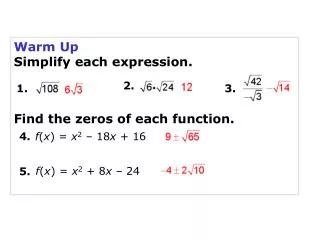
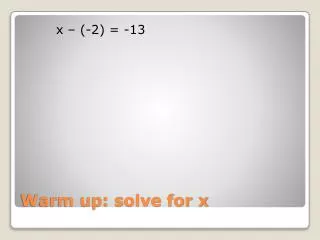
x – (-2) = -13 Warm up: solve for x
Inverse Operations LEQ: What are inverse operations and how do we use them to solve one step equations?
Inverse operations are operations that “undo” each other • For addition and subtraction, inverses are operations that we perform to a number to get 0 • For multiplication and addition, inverses are operations that we perform to a number to get 1
Addition and subtraction are inverses of each other • Addition undoes subtraction • Subtraction undoes addition • Multiplication and Division are inverses of each other • Multiplication undoes division • Division undoes multiplication
1.) 3 ? = 1 The multiplicative inverse of 3 is 1/3. 2.) 3 +___=0 The additive inverse of 3 is -3. 3.) What is the multiplicative inverse of 1/8? 4.) What is the additive inverse of -6? Examples
Ex. 1: 1 + x = 10 Ex. 2: y – 4 = 12 Ex. 3: x + 2 = -13 Ex. 4: x + -2 = -13 Let’s solve equations using inverse properties of addition and subtraction only
1.) 12 + y = 15 4.) -12 = w + -7 2.) 6 + x = -12 3.) 9 = r – 10 On your own: