Download
1 / 11
110 likes | 241 Vues
This presentation outlines the development of a battery-free Tire Pressure Monitoring System (TPMS) by Team 8. It covers the design process, which utilized physics calculations and extensive testing to optimize coil and magnet configurations. The team faced and overcame obstacles related to magnet orientation and coil design, achieving significant voltage generation at various speeds. Key accomplishments include the successful design of test apparatus and circuit improvements, all managed within budget. Next steps involve further refinement of the TPMS components and testing methods.

E N D
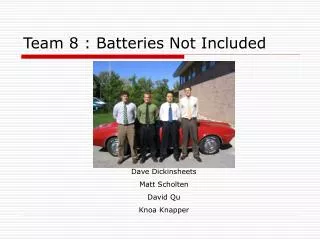
Team 8 : Batteries Not Included Dave Dickinsheets Matt Scholten David Qu Knoa Knapper
Presentation Outline • Project Re-introduction • Design Process • Major Obstacles • Major Accomplishments • Next Steps
Project Re-Introduction Battery-free Tire Pressure Monitoring System
Design Process • Utilized feasibility calculations/physics resources • Number of wraps on coil • Coil diameter • Magnet Orientation • Tested theories on test apparatus • Adjusted design accordingly
Major Obstacles • Magnet Orientation • Proper orientation gives higher voltage • Proper orientation reduces the number of magnets necessary • Coil Design/Manufacturing • Compact coils • Working coils • Mounting
Major Accomplishments • Working test apparatus
Major Accomplishments • Magnet Mounting Bracket Design Magnet Threaded Height Adjustment Caliper Caliper Mounting Holes
3 Volts at ~25 mph 4.5 Volts at ~42 mph 6 Volts at ~60 mph 7.5 Volts at ~75 mph All voltages are half wave heights All speeds are simulated on test apparatus without a tire mounted Major Accomplishments • Voltage Generation Readings taken at 5 V/division on Y-axis 5 ms/division on X-axis
Major Accomplishments • Circuit Design Tested • Half Wave Rectifier • Requires Voltage Regulator • Magnet Orientation • Coil Design Improved • Purchased TPMS System • Budget Under Control
Next Steps • Refine magnet and coil size • Refine circuit design • Mounting design for coil and circuit • Magnet bracket construction • Develop TPMS testing method