Operating and Financial Leverage
Operating and Financial Leverage. 5. Chapter Outline. What is leverage? Operating leverage. Financial leverage. Potential profits or increased risk?. What is Leverage?. Use of special forces and effects to magnify or produce more than the normal results from a given course of action.

Operating and Financial Leverage
E N D
Presentation Transcript
Chapter Outline • What is leverage? • Operating leverage. • Financial leverage. • Potential profits or increased risk?
What is Leverage? • Use of special forces and effects to magnify or produce more than the normal results from a given course of action. • Can produce beneficial results in favorable conditions. • Can produce highly negative results in unfavorable conditions.
Leverage in Business • Determining type of fixed operational costs. • Plant and equipment • Eliminates labor in production of inventory. • Expensive labor • Lessens opportunity for profit but reduces risk exposure. • Determining type of fixed financial costs. • Debt financing • Substantial profits but failure to meet contractual obligations can result in bankruptcy. • Selling equity • Reduces potential profits but minimize risk exposure.
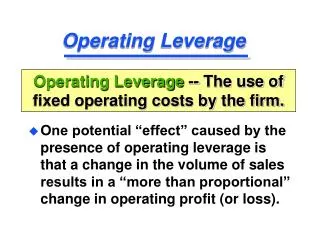
Operating Leverage • The extent to which fixed assets and associated fixed costs are utilized in a business. • Operational costs include: • Fixed • Variable • Semivariable
Break-Even Analysis • The break-even point is at 50,000 units, where the total costs and total revenue lines intersect. Units = 50,000 . Total Variable Fixed Costs Total Costs Total Revenue Operating Income Costs (TVC) (FC) (TC) (TR) (loss) (50,000 X $0.80) (50,000 X $2) $40,000 $60,000 $100,000 $100,000 0
Break-Even Analysis (cont’d) • The break-even point can also be calculated by: Fixed costs = Fixed costs = FC Contribution margin Price – Variable cost per unit P – VC i.e. $60,000 = $60,000 = 50,000 units $2.00 - $0.80 $1.20
A Conservative Approach • Some firms choose not to operate at high degrees of operating leverage. • More expensive variable costs may be substituted for automated plant and equipment. • This approach may cut into potential profitability of the firm as shown in Figure 5-2.
The Risk Factor • Factors influencing decision on maintaining a conservative or a leveraged stance include: • Economic condition. • Competitive position within industry. • Future position – stability versus market leadership. • Matching an acceptable return with a desired level of risk.
Cash Break-Even Analysis • Helps in analyzing the short-term outlook of a firm. • Non-cash items are excluded: • Depreciation • Sales (accounts receivable rather than cash) • Purchase of materials • Accounts payable
Degree of Operating Leverage (DOL) • Percentage change in operating income • Occurs as a result of a percentage change in units sold. • Computed only over a profitable range of operations. • Directly proportional to the firm’s break-even point. DOL = Percent change in operating income Percent change in unit volume
Computation of DOL • Leveraged firm: DOL = Percent change in operating income = $24,000 X 100 Percent change in unit volume $36,000 20,000 X 100 80,000 = 67% = 2.7 25% • Conservative firm: DOL = Percent change in operating income = $8,000 X 100 Percent change in nit volume $20,000 20,000 X 100 80,000 = 40% = 1.6 25%
Algebraic Formula for DOL DOL = Q (P – VC) Q (P – VC) – FC Where, • Q = Quantity at which DOL is computed. • P = Price per unit. • VC = Variable costs per unit. • FC = Fixed costs. • For the leveraged firm, assume Q = 80,000, with P = $2, VC = $0.80, and FC = $60,000: DOL = 80,000 ($2.00 - $0.80) ; 80,000 ($2.00 - $0.80) - $60,000 = 80,000 ($1.20) = $96,000 ; 80,000 ($1.20) - $60,000 $96,000 - $60,000 i.e. DOL = 2.7
Limitations of Analysis • Weakening of price in an attempt to capture an increasing market. • Cost overruns when moving beyond an optimum-size operation. • Relationships are not fixed.
Financial Leverage • Reflects the amount of debt used in the capital structure of the firm. • Determines how the operation is to be financed. • Determines the performance between two firms having equal operating capabilities. BALANCE SHEET Assets Liabilities and Net Worth Operating leverage Financial leverage
Impact on Earnings • Examine two financial plans for a firm, where $200,000 is required to carry the assets. Total Assets = $200,000 Plan A (leveraged) Plan B (conservative) Debt (8% interest) $150,000 ($12,000 interest) $50,000 ($4,000 interest) Common stock 50,000 (8000 shares at $6.25) 150,000 (24,000 shares at $6.25) Total financing $200,000 $200,000
Degree of Financial Leverage DFL = Percent change in EPS Percent change in EBIT • For the purpose of computation, it can be restated as: DFL = EBIT . EBIT – I • Plan A (Leveraged): DFL = EBIT = $36,000 = $36,000 = 1.5 EBIT – I $36,000 - $12,000 $24,000 • Plan B (Conservative): DFL = EBIT = $36,000 = $36,000 = 1.1 EBIT – I $36,000 - $4,000 $32,000
Limitations to the Use of Financial Leverage • Beyond a point, debt financing is detrimental to the firm. • Lenders will perceive a greater financial risk. • Common stockholders may drive down the price. • Recommended for firms that are: • In an industry that is generally stable. • In a positive stage of growth. • Operating in favorable economic conditions.
Combining Operating and Financial Leverage • Combined leverage: when both leverages allow a firm to maximize returns. • Operating leverage: • Affects the asset structure of the firm. • Determines the return from operations. • Financial leverage: • Affects the debt-equity mix. • Determines how the benefits received will be allocated.
Degree of Combined Leverage • Uses the entire income statement. • Shows the impact of a change in sales or volume on bottom-line earnings per share. DCL = Percentage change in EPS ; Percentage change in sales (or volume) • Using data from Table 5-7: Percent change in EPS = $1.50 X 100 Percent change in sales $1.50 = 100% = 4 $40,000 X 100 $25% $160,000
Degree of Combined Leverage (cont’d) DCL = Q (P – VC) , Q (P – VC) – FC – I From Table 5-7, • Q (Quantity) = 80,000; P (Price per unit) = $2.00; VC (Variable costs per unit) = $0.80; FC (Fixed costs) = $60,000; and I (Interest) = $12,000. DCL = 80,000 ($2.00 - $0.80) = 80,000 ($2.00 - $0.80) - $60,000 - $12,000 = 80,000 ($1.20) = 80,000 ($1.20) - $72,000 DCL = $96,000 = $96,000 = 4 $96,000 - $72,000 $24,000