Understanding Ocean Currents: The Dynamics of Density-Driven and Wind-Driven Currents
Ocean currents are crucial for regulating global climate and weather patterns. They can be classified into two main types: density-driven currents, which move water vertically due to differences in water density, and wind-driven currents, which flow horizontally at the surface due to wind friction. Dense water sinks at the poles, while lighter water rises at the equator, creating circulation patterns. Surface currents, influenced by the Coriolis effect, play a significant role in shaping local weather and global oceanic trends, impacting temperatures and climates around the world.

Understanding Ocean Currents: The Dynamics of Density-Driven and Wind-Driven Currents
E N D
Presentation Transcript
Two Types of Currents • Density Driven (deep water) Currents • Wind Driven (surface) Currents
Density Driven Currents • Move water vertically through the ocean • Density differences cause deep water currents • Dense water sinks at the poles • Less dense water rises at the equator • This process creates circulation throughout the oceans of the world
Surface Currents Winds are primary energy source for surface currents. Winds blow across the ocean surface friction between the wind and the ocean surface drags the water along
Which way does the water flow? Rotation of the earth changes path of air and water (Coriolis Effect) Water flows to the right (clockwise) in Northern Hemisphere
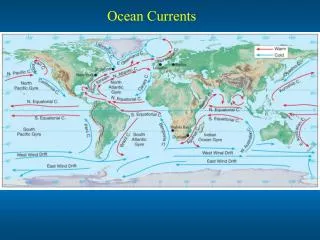
Northern Pacific Surface Currents California Current Kuroshio Current North Equatorial Current Equator South Equatorial Current East Australian Current Peru Current West Wind Drift
Global Surface Currents • Most ocean currents have a dramatic impact on local weather and continental climate patterns • Ex: Mediterranean climate zones
Surface Currents in the US The California Current is cold and comes from Alaska The Gulf Stream is warm and comes from the equator/ Gulf of Mexico San Francisco Washington, DC
What is a gyre? A roughly circular pattern of ocean surface currents Caused by the Coriolis Effect
North Pacific Gyre Equator
Why are gyres/ currents important? • Warm currents move heat from the equator to middle and high latitudes • Gyres influence air temperature, weather and climate of every continent