Download
1 / 11
110 likes | 232 Vues
This guide explores the process of converting Regular Expressions (RE) into Minimal Deterministic Finite Automata (DFA) using Thompson's construction, subset construction, and Hopcroft’s algorithm. It outlines the steps of building NFA for individual terms, combining them, and minimizing the resulting DFA through state partitioning techniques. By iteratively grouping and splitting equivalent states, we ensure an efficient representation of the DFA. This process not only illustrates the theoretical foundations but demonstrates practical applications in efficient pattern recognition.

E N D
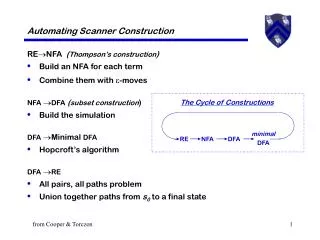
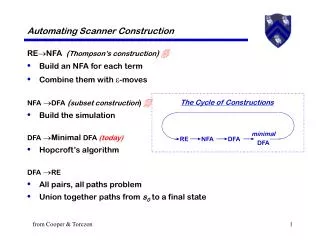
The Cycle of Constructions minimal DFA RE NFA DFA Automating Scanner Construction RENFA (Thompson’s construction) • Build an NFA for each term • Combine them with -moves NFA DFA(subset construction) • Build the simulation DFA Minimal DFA (today) • Hopcroft’s algorithm DFA RE • All pairs, all paths problem • Union together paths from s0to a final state from Cooper & Torczon
DFA Minimization The Big Picture • Discover sets of equivalent states • Represent each such set with just one state Two states are equivalent if and only if: • The set of paths leading to them are equivalent • , transitions on lead to equivalent states (DFA) • transitions to distinct sets states must be in distinct sets A partition P of S • Each s S is in exactly one set pi P • The algorithm iteratively partitions the DFA’s states from Cooper & Torczon
DFA Minimization Details of the algorithm • Group states into maximal size sets, optimistically • Iteratively subdivide those sets, as needed • States that remain grouped together are equivalent Initial partition, P0 , has two sets {F} & {Q-F} (D =(Q,,,q0,F)) Splitting a set • Assume qa, qb, & qcs, and • (qa,a) = qx, (qb,a) = qy, & (qa,a) = qz • If qx, qy, & qz are not in the same set, then s must be split • One state in the final DFA cannot have two transitions on a from Cooper & Torczon
DFA Minimization The algorithm Why does this work? • Partition P 2Q • Start off with 2 subsets of Q {F} and {Q-F} • While loop takes PiPi+1 by splitting 1 or more sets • Pi+1 is at least one step closer to the partition with |Q | sets • Maximum of |Q | splits Note that • Partitions are never combined • Initial partition ensures that final states are intact P { F, {Q-F}} while ( P is still changing) T { } for each set s P for each partition s by into s1, s2, …, sk T T s1, s2, …, sk if T P then P T This is a fixed-point algorithm! from Cooper & Torczon
a a a b b s0 s1 s3 s4 a b a b s2 b b a a a b b s0 , s2 s1 s3 s4 a b DFA Minimization Enough theory, does this stuff work? • Recall our example: ( a | b)*abb final state from Cooper & Torczon
b s2 b a s0 s1 b c c s3 c Final states DFA Minimization What about a ( b | c )* ? First, the subset construction: b q5 q4 a q0 q1 q2 q3 q9 q8 c q7 q6 from Cooper & Torczon
b s2 b | c b a s0 s1 a b c s0 s1 c s3 c DFA Minimization Then, apply the minimization algorithm To produce the minimal DFA final states In lecture 6, I said that a human would design a simpler automaton than Thompson’s construction did. The algorithms produce that same DFA! from Cooper & Torczon
Limits of Regular Languages Advantages of Regular Expressions • Simple & powerful notation for specifying patterns • Automatic construction of fast recognizers • Many kinds of syntax can be specified with REs Example — an expression grammar Term [a-zA-Z] ([a-zA-z] | [0-9])* Op + | - | | / Expr ( Term Op )*Term Of course, this would generate a DFA … If REs are so useful … Why not use them for everything? from Cooper & Torczon
Limits of Regular Languages Not all languages are regular RL’s CFL’s CSL’s You cannot construct DFA’s to recognize these languages • L = { pkqk }(parenthesis languages) • L = { wcw r| w *} Neither of these is a regular language(nor an RE) But, this is a little subtle. You can construct DFA’s for • Alternating 0’s and 1’s ( | 1)( 0 | 1) ( 0 | ) • Sets of pairs of 0’s and 1’s ( 01 | 10 ) ( 01 | 10 )* RE’s can count bounded sets and bounded differences from Cooper & Torczon
What can be so hard? Poor language design can complicate scanning • Reserved words are important if then then then = else; else else = then (PL/I) • Significant blanks (Fortran & Algol68) do 10 i = 1,25 do 10 i = 1.25 • String constants with special characters (C, others) newline, tab, quote, comment delimiters, … • Finite closures • Limited identifier length • Adds states to count length from Cooper & Torczon
What can be so hard? (Fortran 66/77) • How does a compiler do this? • First pass finds & inserts blanks • Can add extra words or tags to • create a scanable language • Second pass is normal scanner Example due to Dr. F.K. Zadeck from Cooper & Torczon