Download
1 / 10
100 likes | 237 Vues
This lesson explores how to find the measure of an arc in a circle, focusing on central angles, minor and major arcs, and semicircles. A central angle is defined as one whose vertex is at the center of the circle, while a minor arc is the portion of the circle that lies within that angle. The major arc includes points outside the angle, and the semicircle spans 180 degrees. Students will learn to apply the Arc Addition Postulate and work through practice problems to solidify their understanding.

E N D
10.2 Finding Arc Measure • Essential Question: • How do you find a measure of an arc of a circle? • Standard • 7.0: Students prove and use theorems involving the properties of parallel lines cut by a transversal, the properties of quadrilaterals, and the properties of circles.
Terms to know: A Central Angle: An angle whose vertex is the Center on the circle. Minor Arc: The points on the circle that lie Within a central angle B c D Major Arc: The points on the circle that Don’t lie within a central angle Semi Circle: An arc with endpoints That are endpoints of a diameter
Measuring Arcs A • The measure of a minor arc • is the measure of its central angle B C • The measure of the entire • Circle is 360 degrees. D • The measure of a major arc is the • Difference between 360 and the measure • Of the related minor arc. • The measure of a semicircle is 180 deg.
ARC ADDITION POSTULATE • The measure of an arc formed by two adjacent arcs is the sum of the measures of the two arcs.
Terms to Know Congruent Circles: Two circles with the Same radius Congruent Arcs: Two arcs With the same measure and Either on the same circle or Congruent circles
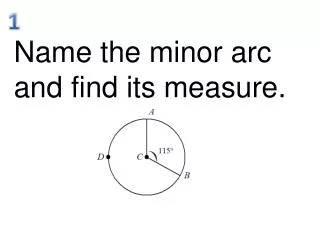
Practice In Circle C, Find the measure of the arc. C
Homework: Page 661-662: 1 – 17 all, 20