Download
1 / 2
20 likes | 153 Vues
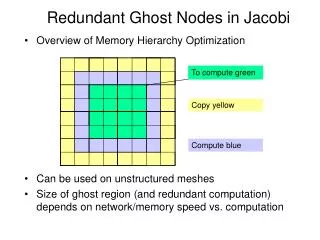
This overview discusses the optimization of ghost nodes in the Jacobi method, focusing on memory hierarchy and redundant computation. It emphasizes the size of ghost regions and how it is influenced by the speed of network/memory in relation to computation efficiency. The method operates on unstructured meshes and requires O(sqrt(N)) iterations for information propagation on an n x n grid, particularly in scenarios where the right-hand side (RHS) is mostly zero with a non-zero center value. This analysis aids in enhancing convergence in nearest neighbor methods.

E N D
Redundant Ghost Nodes in Jacobi • Overview of Memory Hierarchy Optimization • Can be used on unstructured meshes • Size of ghost region (and redundant computation) depends on network/memory speed vs. computation To compute green Copy yellow Compute blue
Convergence of Nearest Neighbor Methods • Jacobi’s method involves nearest neighbor computation on nxn grid (N = n2) • So it takes O(n) = O(sqrt(N)) iterations for information to propagate • E.g., consider a rhs (b) that is 0, except the center is 1 • The exact solution looks like: Even in the best case, any nearest neighbor computation will take n/2 steps to propagate on an nxn grid