Download
1 / 13
130 likes | 222 Vues
Learn how to solve mixture problems involving solutions with varying percentages of specific components. Three different examples illustrate the process step by step. Understand how to calculate the amount of a particular substance in a solution.

E N D
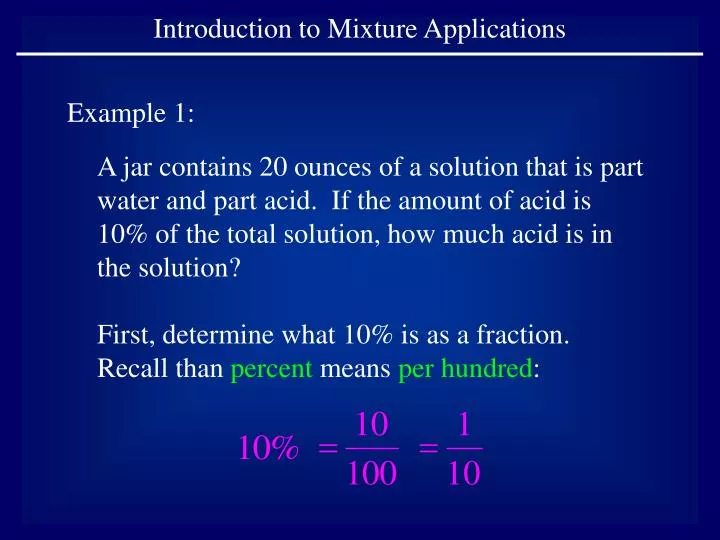
Introduction to Mixture Applications Example 1: A jar contains 20 ounces of a solution that is part water and part acid. If the amount of acid is 10% of the total solution, how much acid is in the solution? First, determine what 10% is as a fraction. Recall than percent means per hundred:
20 ounces total water & acid
The acid is 10% of the total: of the total 20 10%
Review the expression that gave us the amount of acid: of the total 20 20 In decimal form … 10% 10% = (percent acid) × (total amount)
Introduction to Mixture Applications Example 2: A jar contains x ounces of a solution that is part water and part acid. If the amount of acid is 10% of the total solution, how much acid is in the solution?
x ounces total water & acid
The acid is 10% of the total: of the total x 10% = (percent acid) × (total amount)
There are 0.10x ounces of acid in the solution. 0.10x oz. = (percent acid) × (total amount)
Introduction to Mixture Applications Example 3: A jar contains x ounces of a solution that is part water and part acid. If the amount of acid is 65% of the total solution, how much acid is in the solution? Amount acid = (percent acid) × (total amount)