
Hormone actions
E N D
Presentation Transcript
Hormones • Three subgroups based on chemical nature • Proteins • Lipids • Cholesterol • Eicosanoids • Animo acid derivatives
Hormones • Biological activities • Mediated by the receptor • Receptors • Protein • Interacts with specific hormone • Diverse • Membrane-bound • Intracellular/nuclear
Interactions between hormone and receptor • Very specific • Depending upon the structural conformation • 3-D structure • Chemical structure • Side-chains • Rings • Some receptors bind to more than one hormone • Glucocorticoids bind to progesterone receptor and vise varsa • Effectiveness differ based on what hormone is bound to the receptor
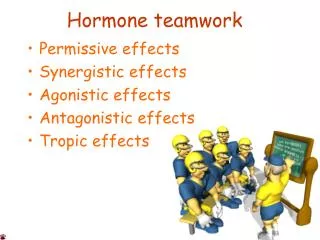
Interaction of hormone with its receptor • Natural hormone • Synthetic hormone (same chemical composition and structure) • Analogues • Synthetic hormone that elicit greater response • Agonist • Synthetic hormone that prevents response • Antagonits
Regulation of hormone activity • Factors • Amount of hormones available • Free form • Available to interact with receptor • Amount of receptors present • Production • Transcription of mRNA for the receptor • Translation of mRNA for the receptor • Occupancy of the receptor
Factors • Rate of clearance • Circulation • Receptor turn-over • Removal/recycling of receptor after the hormone binds
Transduction of hormonal signals • Interaction of hormone with its receptor • Generation of intracellular signals • Different among different hormones • Production of chemicals within the cell • Secondary messenger • Interaction with DNA • Nuclear receptors
Protein hormones • Alteration of intracellular chemistry • Changes in concentrations of biochemical molecules • Alteration of biochemical molecule activity • Activation/inhibition of intracellular proteins
Types of intracellular signaling • Types of receptor • G-protein coupled receptors (very common) • Seven trasmembrane domain receptor • Intracellular proteins (G-proteins) • Activated by attachment of GTP to one of the G-proteins • Activated G-protein in turn activates other intracellular proteins • Secondary messenger • Cyclic AMP (cAMP) • Phosphatidyl inositol and Ca ions
Types of receptor • Proteins with intrinsic kinase activity • Attach phosphate ions to itself (tyrosine residue) • Activation of other intracellular proteins through phosphorylation • Proteins that have intracellular kinase associated • Binding of hormone results in phosphorylation of associated kinase rather than the receptor protein itself • Results of receptor activation • Activation of transcription • Often affects metabolism and growth of cell
Nuclear hormone receptors • Steroid hormone receptors • Two domains • Ligand binding domain (binds hormone) • DNA binding domain • Require dimerization • Two receptors interact with each other • Homodimer or hetelodimer • Interacts with DNA • Hormone responsive element • Triggers transcription of hormone-responsive genes
Hormone concentrations in blood • Fluctuation in blood concentrations of hormone • Secretion pattern • Variation throughout the day • Rhythmic pattern • Circadian rhythm • Pulse-like pattern • Surge-like pattern
Availability of hormone to the receptor • Free form • Hormone itself • Bound form • Hormone plus other blood protein(s) that binds to hormone • Sex hormone-binding globulin (SHBG) • Insulin-like growth factor-binding proteins (IGFBPs) • Regulation of free form being available for action
Metabolism of hormone • Cleared as it goes through the circulation • Liver • Lungs • Cleared at the site of action • Receptor internalization • Metabolic clearance
Reproductive organs • Development and function • Regulated by hormones • Gonadotropins • Steroids • Prostaglandins • Growth factors • Production of hormones • Control of the central nervous system
Neural control • Hypothalamus • “Old” part of brain (primitive brain) • Involved in homeostasis of internal environment • Sensory information from external environment • Generation of appropriate response
Anatomy of hypothalamus • Landmarks • Anterior (front) • Optic chiasm (crossing of optic nerve fibers) • Posterior (dorsal/back) • Mamillary body • Superior (cranial) • Third ventricle • Inferior • Pituitary stalk/infundiblum
Neural organization of hypothalamus • Clusters of neurons • Nucleus/nuclei • Different section of hypothalamus contains different nuclei
Regional distribution of nuclei • Supraoptic • Paraventricular • Arcuate • Ventromedial • Suprachiasmatic • Medial anterior hypothalamic • Medial preoptic area
Hypothalamic control of hormone production • Neural connection to the pituitary gland • Posterior pituitary gland (neurohypophysis) • Neural cells that produce oxytocin and vasopression are located in the hypothalamus • Hormones transported to the posterior pitutiary gland via axoplasmic flow • Axons of neurons extended into the posterior pituitary gland • Magnocellular neurosecretory system
Hypothalamic control of hormone production • Circulatory connection to the pituitary gland • Anterior pituitary gland (adenohypophysis) • Neural cells that produce releasing factors are located in the hypothalamus • Axons terminate in primary portal plexus of capillaries located in the median eminence • Parvocellular neurosecretory system • Hormones transported to the anterior pitutiary gland via portal vessels • Microcirculation between the hypothalamus and anterior pituitary gland
Gonadotropin-releasing hormone (GnRH) • Hypothalamic neuropeptide • 10 amino acids • Produced by the neurons • Caudal medial septal nucleus • Paraventricular medial preoptic area • Released into the circulation via lateral parisade zone of the portal plexus
Gonadotropin-releasing hormone (GnRH) • Crucial hormone for regulation of gonadal function • Controls release of gonadotropins (LH and FSH) • Pattern of release is reflected in pattern of blood gonadotropin concentrations • Pulsatile • Surge-like
Pulsatile secretion of GnRH • Critical for function of gonads • Pulsatile secretion of LH and FSH • Pulse generator • Neurons in median eminence • Circhoral clock