Induction and Signaling in Embryonic Development: Mechanisms and Pathways
This lecture explores the intricate processes of induction and cell signaling during embryonic development. It focuses on the requirements of inducer and responder cells, the cascades of inductive events forming organs, and significant signaling pathways such as Notch, TGF-β, Sonic Hedgehog (SHH), Wnt, and FGF. Key concepts including competence, instructive, permissive, and selective interactions are discussed, along with cellular communication examples and the role of cell surface receptors and transcription factors in inductive processes.

Induction and Signaling in Embryonic Development: Mechanisms and Pathways
E N D
Presentation Transcript
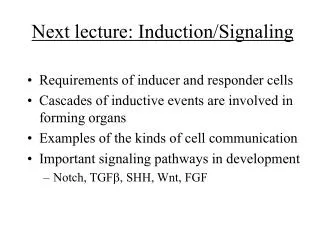
Next lecture: Induction/Signaling • Requirements of inducer and responder cells • Cascades of inductive events are involved in forming organs • Examples of the kinds of cell communication • Important signaling pathways in development • Notch, TGFb, SHH, Wnt, FGF
“Official glossary” from Wolpert • Induction: The process whereby one group of cells signals to another group of cells in the embryo and so affects their development • Competence: The ability of a tissue to respond to an inducing signal. Embryonic tissues remain competent for a limited time (Can depend on prior inductive events)
Competence factors • Not all tissues are able to respond to the same signals. Competence is actively acquired • Receptors, signaling molecule • Transcription factors (chromatin state) • Competence factors are specifically required in the responding tissue, not the inducer • Demonstrated in recombination experiments
Recombination experiments: First name the players…(fig 6.1 from Gilbert)
Cascades of inductive events form the organ: Reciprocal induction Of Gilbert
Two kinds of induction(plus one) • Instructive interaction: A signal or factor which tells the developing cell what it is • Permissive interaction: A signal or factor that allows the cell to become what it is • Selective interaction. A factor allows the cell to be “selected” into one lineage or another after a stochastic (random) change
For example, CD4 vs. CD8 T cells Selection vs. Instruction TCR-I CD8 TCR-II CD4
Juxtacrine interactions • Involve cell surface receptors on inducer and responding cells (no soluble factors) • Cell death/apoptosis pathways • Fas (CD95)/FasL • Notch/delta pathway • Involved in many binary cell fate decisions • Examples in flies, worms and mice
Cell death pathways Figure 6.27 of Gilbert
Notch is involved in a wide array of binary cell fate decisions • C. elegans:Ventral uterine vs. Anchor cell and vulval development • Drosophila: Neural vs. Epidermal cells • Mouse: Embryonic lethal, Demonstrated affects in the immune system and others • Human: Notch deficiencies cause birth defects
Notch/delta pathway(fig 6.29 of Gilbert) This model is simplistic little evidence for nuclear localization of Notch in developing organisms
Players in the Notch pathway • Receptor family: Notch/lin-12, glp-1 • Ligands: (DSL) Delta, Serrate, Lag2, Jagged • Processing: ADAMs (Kuz, TACE) and Secretases (Sel-12/presenilins) • Downstream effectors: CBF1, Su(Hairless), Lag1 (Collectively called CSL)
Proteolytic processing of Notch is complicatedFigure 1 from Weinmaster (2000)Curr. Opin. Genet. Dev. 10:363-369
Presenilins • Multipass transmembrane proteins • Mutated in inherited, early onset Alzheimer's disease • Involved in cleavage of amyloid precursor protein (APP) • Evidence that they are proteases or co-factors of a protease
Evidence linking presenilins with Notch signaling • Homology between PS1 and Sel-12 of C.elegans (sel-12 facilitates Notch signaling) • PS and Notch deficient animals have similar phenotypes (Drosophila and mice) • PS is required for access of Notch to the nucleus and, thus, Notch signaling • Defects can be rescued by providing exogenous PS
Current view of Notch signalingFigure 2 from Weinmaster (2000) Curr Opin Genet. Dev. 10:363-369
Notch involvement in cell fate • Examples of Notch involvement in inductive interactions (signaling between non-equivalent cells) • Lateral specification (occurs in a population of equivalent cells) • Involves the amplification of a stochastic small difference between equivalent cells
Lateral specification in C. elegansFrom Greenwald (1998) Genes. Dev. 12:1751-62
Evidence for feedback mechanism in lateral specification • Constitutive active mutants of lin12 have no AC • Mutants eliminating lin12 activity have 2 AC • Mixing experiments between two types above • Lin12 - cells always became AC • Lin12 WT cells always became VU • Behavior different from WT in non-mosaic situation where these cells have equal chance to become AC or VU
One way to generate a bias in Notch activity-C. elegans vulval developmentFrom Greenwald (1998) Genes. Dev. 12:1751-62 fate adoption is 2o-1o-2o
Gilbert Chapter 6 errors • Lag2 is not secreted but transmembrane. This is the ligand for lin12/Notch (p.169) • Figure 6.40 on T-lymphocyte signaling: The pathways leading from the receptors are not correct. (Notice, there is no reference) • Figure 6.19: Details appear to be in dispute
Paracrine factors and interactions • Transforming Growth Factor (TGF)-b • Sonic Hedgehog • Wnt • Fibroblast Growth Factor (FGF) • Retinoic Acid (RA)
TGF-b • Over 30 members of the TGF-b family • Subfamilies, TGFb, Activin, BMP, Vg1 • Processed proteolytically with the C-terminal region conatining the mature peptide • TGFb peptides can homo- or hetero-dimerize • TGFb signal transduction involves multiple receptors which activate cytoplasmic “Smads”
Division of labor among SmadsCourtesy of J.F. Doody (J. Massague lab @MSKCC) Smad 6 and 7 are inhibitory proteins induced by antagonists of the TGFb signaling pathway, such as g-interferon (Smad7)
The Smad familyFrom Piek, et. al. (1999) FASEB J. 13:2105-2124
A more complete TGFb pathway From Piek, et. al. (1999) FASEB J. 13:2105-2124
Evidence for non-redundant TGFb family involvement in development(due to expression patterns) • TGF-b1 knockout mice have defects in blood and vasculature (many die prenatally) • TGF-b2 knockout mice have multiple organ malformation (perinatal death) • TGF-b3 knockout mice die shortly after birth due to defects in pulmonary development • Information from Piek, et. al. (1999) FASEB J.
Next lecture: Induction/Signaling • Requirements of inducer and responder cells • Cascades of inductive events are involved in forming organs • Examples of the kinds of cell communication • Important signaling pathways in development • Notch, TGFb, SHH, Wnt, FGF