Mapping from Data Model (ERD) to Relational Model
390 likes | 512 Vues
This guide outlines the process of transforming conceptual database designs (ERD) into logical database designs suitable for implementation on a DBMS. It covers key principles including the creation of relational schemas, normalization of relations, and adherence to user needs such as data sharing and accessibility. The text emphasizes the importance of maintaining referential integrity, managing primary and foreign keys, and addressing complexities in relationships. Additionally, it illustrates the handling of composite attributes and multi-valued attributes through normalization.


Mapping from Data Model (ERD) to Relational Model
E N D
Presentation Transcript
Mapping from Data Model (ERD) to Relational Model Yong Choi School of Business CSUB
Objectives of logical design... • Transform the conceptual database design into a logical database design that can be implemented on a chosen DBMS later • Input: conceptual model (ERD) • Output: relational schema, normalized relations • Resulting database must meet user needs for: • Optimal data sharing • Ease of access • Flexibility
Why do I need to know this? • CASE tools can perform many of the transformation steps automatically, but.. • Often CASE tools cannot model complexity of data and relationship (Ternary relationships, supertype/subtypes, i.e..) • You must be able to perform a quality check on CASE tool results * Mapping a conceptual model to a relational schema is a straight-forward process…
Basics * A conceptual model MUST NOT include FK information * • An entity turns into a table. • Each attribute turns into a column in the table. • The (unique) identifier of the entity turns into a PK of the table.
Basics (con’t) • There is no such thing as a multi-valued attribute (phone #) in a relational database. • If you have a multi-valued attribute, take the attribute and turn it into a new entity of its own thru the normalization process (see later slide..).
Some rules... * Remember! The Relational DB Model does not like any type of redundancy. • Every table must have a unique name. • Attributes in tables must have unique names. • Every attribute value is atomic. • The order of the columns is irrelevant. • The order of the rows is irrelevant.
The key... • Relational modeling uses primary keys and foreign keys to maintain relationships • Primary keys are typically the (unique) identifier noted on the conceptual model
The key... (con’t) • Foreign keys are the PK of another entity to which an entity has a relationship • Example: “PK as FK” & “Referential integrity” • Composite primary keys are keys that are made of more than one attribute • Weak entities • Bridge entities (M:N relationship)
Constraints… • Entity integrity constraints • A PK attribute must not be null. • Referential integrity constraints • Matching of primary and foreign keys
Emp_Id Emp_Lname Emp_Fname Salary Mapping an entity into a relation • An Entity name: Employee • Attributes: • Emp_ID, Emp_Lname, Emp_Fname, Salary • Identifier: Emp_ID Employee
Mapping an entity into a relation Movies Movies title year length filmType Title Year Length Film Type Star Wars 1977 124 color Mighty Ducks 1991 104 color Wayne’s World 1992 95 color
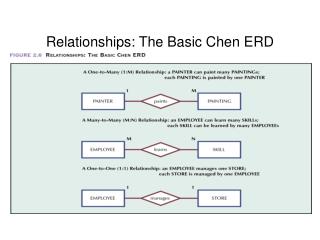
Mapping binary relationships • One-to-one: PK on the mandatory side becomes a FK on the optional side • one-to-one mandatory relationship • Restaurant DB: BillingAddress and Customer • One-to-many: PK on the one side becomes a FK on the many side • Many-to-many - create a new relation (bridge entity) with the PKs of the two entities as its composite PK
Mapping a 1:1 relationship with optional on the one side • Nurse: • Nurse_ID, Name, Date_of_Birth • Care Center • Center_Name, Location, Date_Assigned
Mapping a 1:1 relationship OK to use Nurse_ID Access: - Name must be matched FK: Nurse_ID
Mapping a 1:M relationship • Customer: • Customer_ID, Customer_Name, Customer_Address • Order: • Order_ID, Order_Date
Mapping M:N relationship Each student takes many classes, and a class must be taken by many students. STUDENT CLASS IS_TAKEN_BY TAKE
Example M:N Relationship Table to represent Entity 3 to 3 30 to 30 300 to 300 3000 to 3000 30,000 to 30,000 300, 000 to 300, 000
CLASS ENROLL STUDENT Transformation of M:N • When transform to relational model, many redundancies can be generated. • The relational operations become very complex and are likely to cause system efficiency errors and output errors. • Break the M:N down into 1:N and N:1 relationships using bridge entity (weak entity).
Converting M:N Relationship to Two 1:M Relationships Bridge Entity
Mapping an M:N relationship Student Enroll Class
Mapping an M:N relationship 2 Warehouse A component of composite PK is a FK of other relations StockInfo Product
Mapping composite and Multi-valued attributes to relations • Composite attributes: use only their simple, component attributes – divide into atomic and separate attribute. • Multi-valued attributes: become a separate relation with a FK taken from the superior entity.
Mapping composite attributes to relations Composite attribute Customer Customer_ID Customer_Name Customer_Address
Mapping a multi-valued attribute Employee SSN Name Phone #
Mapping a weak entity • Becomes a separate relation with a FK taken from the superior entity • Primary key composed of: • Partial identifier of weak entity • Primary key of identifying relation
Mapping a weak entity Employee NOTE:The FK of DEPENDENT should NOT allow null value if DEPENDENT is a weak entity Dependent FK
Mapping 1:M recursive (or unary) relationships Employee FK • Manager_ID references Emp_ID
Mapping M:N recursive (or unary) relationships • In manufacturing assembly line, several items consist of multiple items as components. • One item can be used to create other items. • Associations among items are M:N. • the associations among items are M:N. That is, there is a M:N unary relationship.
Mapping M:N recursive (or unary) relationships Has_components (a) Bill-of-materials relationships (M:N) Used_by (b) ITEM and COMPONENT relations
Mapping Supertype/subtype relationships • Create a separate relation for the supertype and each of the subtypes • Assign common attributes to supertype • Assign PK and unique attributes to each subtype • Assign an attribute of the supertype to act as subtype discriminator
Mapping Supertype/subtype relationships Sub symbol