Download
1 / 19
190 likes | 306 Vues
This study presents an in-depth analysis of open heavy flavour production at HERA, focusing on charm and beauty quark production through photoproduction and deep inelastic scattering (DIS). We discuss selected results, including charm fragmentation and the extraction of gluon densities from data. Utilizing perturbative QCD (pQCD) and NLO calculations, we reveal how experimental results align with theoretical predictions. The universality of charm fragmentation and the discrepancies in beauty production cross sections are critically examined, highlighting the need for further data to refine our understanding of these phenomena.

E N D
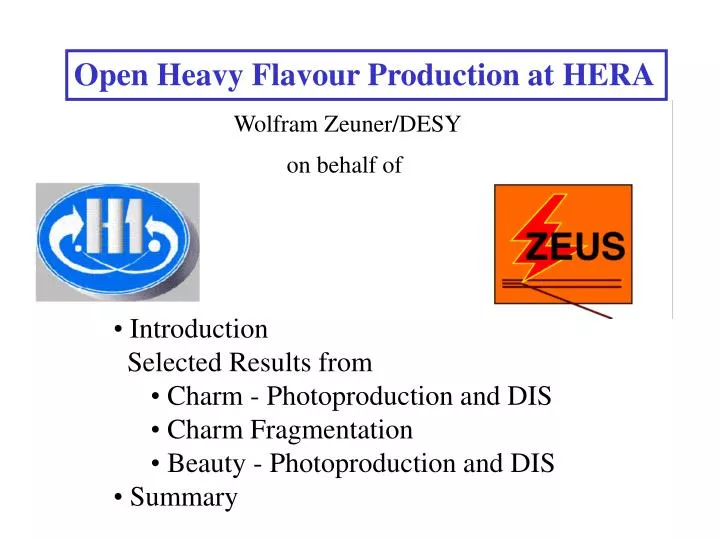
Open Heavy Flavour Production at HERA Wolfram Zeuner/DESY on behalf of • Introduction • Selected Results from • Charm - Photoproduction and DIS • Charm Fragmentation • Beauty - Photoproduction and DIS • Summary
Open Heavy Flavour Production at HERA • Study c and b production • Hard scale from mQ tests of pQCD • Access to gluon in proton and photon • Study non-perturbative effects • as fragmentation LO (s) Direct BGF Resolved photon + ... In higher order only the sum of all contributions is well defined Flavour excitations
Kinematic Variables • ep collisions: Ee=27.5 GeV, Ep=820/920 GeV • HERA produces boson proton interactions Luminosities e-p: 15 pb-1 e+p: 120 pb-1 • Kinematic regions • Photoproduction (p) : Q20 • Deep Inelastic Scattering (DIS): 1Q2 5·104 GeV2
Calculations and Models Perturbative QCD 1. Fixed order NLO QCD (FO) calculations Heavy Quark produced only in hard scattering DIS: B. W. Harris, J. Smith, Phys. Rev D57, 2806 (1998) - HVQDIS MC p: Frixione et al.,Nucl. Phys. B454 (1997) 3 2. Resummed calculations in NLO (RS) Heavy Quark is an active flavour inside the proton and photon B. Kniehl et al. Z. Phys C76 (1997) 690; J. Binnewies et al., Z. Phys C76 (1997) 677; Phys. Rev. D58 (1998) 14014 M. Cacciari et al., Phys. Rev. D55 (1997) 2736; ibid 7134 3. Variable flavour numbers (VFNS), flavours are active depending on scale M.A.G. Aivaizis et al. Phys. Rev. D50 3102 (1994) (ACOT) • LO Monte Carlo Calculations – (BGF) • AROMA (direct only), HERWIG and PYTHIA (direct+resolved) • DGLAP evolution – (Q2 ordering) • CASCADE based on CCFM evolution – (angular ordering) Typical scales p: DIS:
Open Charm Production • Charm tagging through D*± mesons 31350 ± 240 using M method • Other decays and mesons are used • semi leptonic electrons - via dE/dx
ZEUS 96+97 Charm cross sections - D* and Ds in p • FO QCD (FMNR) • p: MRSG, : GRV-G HO • Thin: mc=1.5 GeV, R= mT= F/2 • Thick: mc=1.2 GeV, R= 0.5 mT • f(cD*)=0.235 (LEP) • Data more precise than prediction • Normalisation, low and par. dependent RS QCD (Kniehl et al.) p: CTEQ4M, mc=1.5 GeV, R= mT= F/2 • Problems to describe shape • Too low at high • Sensitive to -PDF • Best with GS-G-HO, but u=c
Charm Production in DIS Double differential D* production cross section • QCD predictions: bands (mc,c) : (1.3 GeV,0.35) - (1.5 GeV, 0.01) • HVQDIS - NLO DGLAP prediction too low for low pt and positive • CASCADE - LO CCFM MC describes data better
Assumptions • NLO FO calculation (BGF) • Neglect bound charm (2.5-4.5%) • Neglect • BR(c D*) = 0.222 - 0.233 from e+e- • Extrapolate to full phase space • in pT and h • Fragmentation effect on the • extrapolation is small Charm Production in DIS - • All measurements agree • Data described by NLO QCD • Strong scaling violations • Steep rise toward low x • Ratio grows towards • low x ( >25% for Q2 6.5 GeV2)
Open Charm Production - The Gluon Density Distribution Reconstruct gluon momentum fraction xg from e and D* Extract xgg(xg,Q2) by unfolding differential D* cross sections using FO NLO calculations xgg(xg,Q2) xg Gluon parton density from D* in p and DIS agree with QCD fit to inclusive DIS cross section
Unexpected observation Charm Production in DIS - D* • The ratio (e-p)/(e+p) rises towards • high Q2 and high x • Both cross sections are compatible • with NLO prediction within errors More data needed
Charm Fragmentation - Universal ? • Fragmentation fractions of excited D and Ds mesons • Strangeness production from • Ds (K+ K-) vs. D*D0 (K ) • Strangeness suppression factor s of LUND model
Charm Fragmentation - Universal ? • Production of vector mesons (D0) vs pseudoscalar mesons (D*) assume (D*±) = (D*0) PV= 0.546±0.045±0.028 ZEUS 0.57 ±0.05 OPAL 0.595 ±0.045 ALEPH D0 from D*± D0 not from D*± • No difference in charm fragmentation found between ep and e+e- collisions • All experimental results favour universality of charm fragmentation
Jet Axis or Thrust Axis ptrel Lepton Jet Jet >0 <0 Open Beauty Production High quark mass pQCD, but cross section low b/ c 10-2 • B Tagging: • Semi-leptonic decays with a ptrel method - H1+ZEUS • Impact parameter method - H1 • using lifetime information - • Intercept of muons from semi-leptonic • decays in the transverse plane
Beauty in Photoproduction H1 - Muon Analysis Combined likelihood fit to ptrel and Combine with earlier ptrel measurement B fraction 27±3 % - from fit to MC • Predictions: • NLO (FMNR) 54 ±9 pb • AROMA (LO no resolved) 38 pb • CASCADE (LO CCFM-splitting) 66 pb All predictions significantly below data
Beauty in Photoproduction • ZEUS electron analysis • Electrons identified by dE/dx of tracks Fitted b fraction: 14.7±3.8% - HERWIG predicts 16.2% Cross section by MC (LO) on the low side HERWIG: 8pb, Pythia: 18 pb, Cascade 20 pb
Beauty in Photoproduction ZEUS Muon Analysis From fit: fb~30% • Pythia with b excitation describes data reasonably well • NLO ? – more data on tape to be analysed
Beauty in DIS First observation of b production in DIS by H1; analysis like in p Sample: 168 events Combined fit in ptrel and fb= 43±8% Predictions: NLO QCD: = (11±2) pb LO MC - AROMA: = 9 pb CASCADE: = 15 pb
Summary - Open Beauty Production at HERA Measured cross section exceeds NLO calculation in p and DIS • LO -Monte Carlo predictions are always on the low side • Quark excitation improves agreement in central region • CCFM improves agreement in central region • Forward region too low in all predictions
SUMMARY • Large mass of c and b defines hard scale for pQCD • Charm - total cross sections predictable • p cross section higher than predicted by LO-MCs and NLO calc. at high • DIS cross section higher than predicted at high , low x and low Q2 • Beauty Cross section measured in p and DIS • clearly underestimated by NLO predictions - surprising • NNLO Calculations and MCs are needed • Investigation of interactions with p-remnant (DIS) or -remnant (factorisation) • Need to investigate non-perturbative effects • Charm fragmentation - no difference seen between e+e- and ep • What comes next ? • HERA has been upgraded for high luminosity - 1fb-1 until 2006 • Detectors have been upgraded - higher sensitivity and efficiency • Precision measurements, QCD tests • and detailed investigations of the gluon in the proton, surprises not excluded