Download
1 / 10
100 likes | 211 Vues
This overview explores the qualifications and roles of the President and Vice President of the United States, detailing age, residency, and citizenship requirements. It explains the Electoral College system, the selection of electors, and the significance of majority votes in elections. The responsibilities of the Executive Branch, including appointment powers, executive orders, and budget management, are also discussed, alongside the roles of cabinet departments and regulatory agencies, providing a comprehensive insight into U.S. governance.

E N D
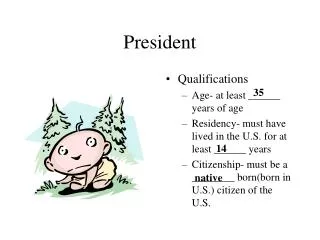
President • Qualifications • Age- at least ______ years of age • Residency- must have lived in the U.S. for at least ______ years • Citizenship- must be a ________ born(born in U.S.) citizen of the U.S. 35 14 native
Vice President • Role and Responsibilities • President of the __________ • Duties as assigned by the President • Qualifications • Same as the ________ Senate President
Electoral College most • The slate of electors for each state is chosen by popular vote. The candidate who receives the _______ votes in a state gets ______ the state’s electors • The electors meet in their ________ capital and vote for President and Vice-President • The candidate who receives the __________ (270 of 538 elector votes) wins the presidency all State’s majority
Executive Branch/President • Powers and Responsibilities • Approve or veto ___________ • Negotiates ____________ • Commander in Chief • Chief of state • Prepare __________ • ________________-judges ambassadors, cabinet officers • State of the _________ address • Executes/Enforces ________ bills treaties the budget Appoint Union laws
Electoral College • The number of electors a state has is based on the state’s __________________representation. (Representatives plus Senators) Congressional
Electoral College • The winner-take-all system leads to targeting of large states for campaigning, although candidates must pay attention to small states whose electoral votes may make the difference in tight elections
Electoral College • The requirements for a majority vote (____ of 538 elector votes) to win in the electoral college favors a ____-party system 270 two
Electoral College • If no candidate wins a majority (270) of votes in the Electoral College • The House of ______________ will select the president Representatives
Executive Branch Advisors • Cabinet Departments (Group of _________ to the President) • Defense, State, Treasury, etc… • Agencies • CIA (Central ___________ Agency), FDA (________ and Drug Administration), EPA (Environmental ____________ Agency-protects the environment) • Regulatory groups • FTC (Federal _______ Commission)- Works against _____________/unfair business practices Intelligence Food Protection Trade monopolies
Executive Branch (cont.) • Regulatory Groups (cont.) • FCC (Federal _________________ Commission)- regulates _________, cable, radio, and telephone • Federal _____________ Board- sets monetary policy/interests rates. Regulates _________ supply in the economy Communications television Reserve money