Electrical Safety: Recognizing Hazards in the Workplace
200 likes | 309 Vues
This document outlines critical electrical hazards that employers must recognize and mitigate to ensure worker safety. It emphasizes the importance of maintaining safe distances from electric power circuits, proper handling of extension cords, and addressing common hazards such as GFCI absence, ungrounded systems, and damage to electrical components. It also covers essential safety measures, such as protecting conductors from abrasion and avoiding pinch points for flexible cords. Employers are urged to keep workplaces safe and ensure all electrical systems are well-maintained.


Electrical Safety: Recognizing Hazards in the Workplace
E N D
Presentation Transcript
Yes No employer shall permit a worker to work in such proximity to any part of an electric power circuit that the worker could contact the electric power circuit in the course of work
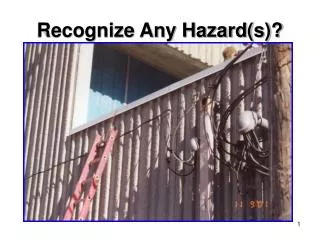
Yes Crossing electrical line must be supported, protected or removed to safeguard workers
Yes Spliced electrical extension cords. Extension cords should be marked DO NOT USE. Also, bad housekeeping, trip hazard and unprotected hole in photograph
YES 1. No GFCI 2. System not grounded 3. Openings where conductors entered not closed 4. No cover on boxes 5. Panel boards were not dead front
YES Electric drill flexible cord was spliced to a non-flexible conductor with damaged insulation
Yes Scaffold was erected 4 ½ feet from 7.2 kV power lines
YES Continuous path to ground not maintained; multiple cords used for fixed equipment
YES Employer was operating a stand fan without grounding protection
Yes Conductors entering boxes, cabinets, or fittings shall be protected from abrasion. Openings through which conductors enter shall be effectively closed
Yes Flexible cords and cables may pass through doorways or other pinch points, if protection is provided to avoid damage