Understanding Complex Numbers: Vocabulary and Properties
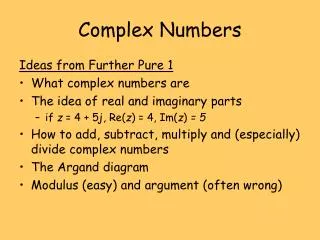
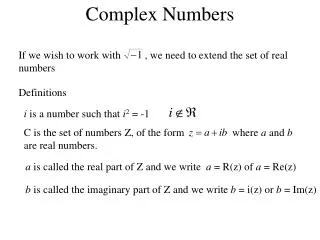
In this unit, we explore the fundamentals of complex numbers, including essential vocabulary such as square roots, radicals, and the imaginary unit (i) defined as (i = sqrt{-1}). We distinguish between real parts, imaginary parts, and delve into properties of square roots. Learn how to express complex numbers in standard form and simplify various expressions. Additionally, we cover the equality of complex numbers with practical examples, ensuring a clear understanding of both theoretical concepts and their applications in mathematics.

Understanding Complex Numbers: Vocabulary and Properties
E N D
Presentation Transcript
Writing complex numbers Unit 1: topic 3
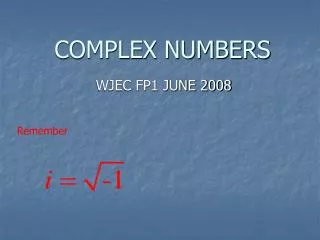
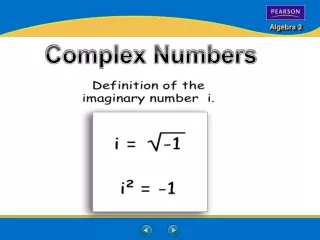
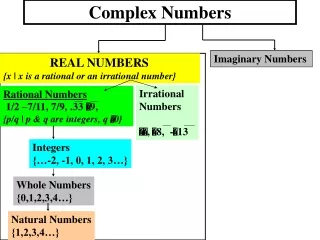
VOCABULARY • Square root: A number r is a square root of a number if r2 = s • Radical: the symbol √ is a radical sign • Radicand: the number beneath the radical sign • Imaginary unit i: defined as • i = √-1 • i2 = -1
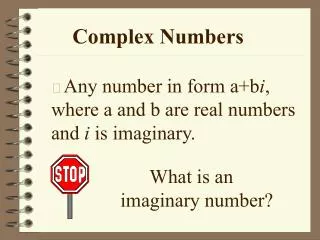
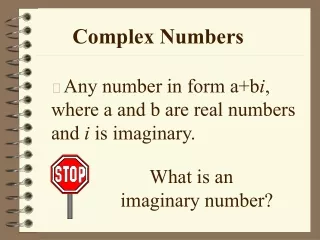
VOCABULARY • Complex number: written in standard form a + bi • a and b are numbers • a is the real part • b is the imaginary part • Imaginary number • If b ≠ 0, then a+ bi is an imaginary number • Pure imaginary number • If a = 0 and b ≠ 0, then a + bi is a pure imaginary number
Properties of square roots • Simplify the expression • Ex1: √8 * √6 • = √48 • = √48 2 24 2 12 2 6 2 3 • = 4√3
Properties of square roots • EX 2: √5/36 • EX 3: √300 • EX 4: √20/81
Write complex numbers in standard form • Ex1: √-9 • = √9 *√-1 • = 3i • Ex2: √-12 • = √12 * √-1 • = 2√3 * i • = 2i√3 • Ex3: 4 + √-16 • = 4 + √16 * √-1 • = 4 + 4i
Equality of Complex Numbers • Ex1: 2x + 2yi = 6 + 4i • Set real parts equal • 2x = 6 • X = 3 • Set imaginary parts equal • 2y = 4 • Y = 2