Software Quality
Learn about the key aspects of software quality, including analysis, design, testing, and adherence to standards. Explore quality factors like correctness, reliability, efficiency, and more. Discover the history, activities, reviews, metrics, and maturity index in software quality assurance. Improve your software development process for optimal results.

Software Quality
E N D
Presentation Transcript
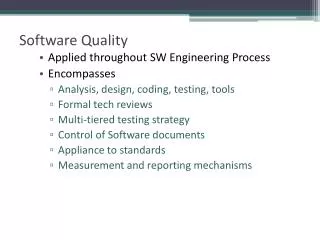
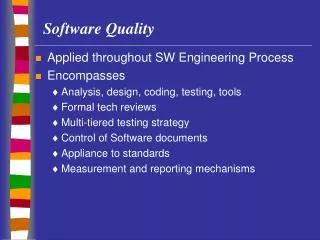
Software Quality • Applied throughout SW Engineering Process • Encompasses • Analysis, design, coding, testing, tools • Formal tech reviews • Multi-tiered testing strategy • Control of Software documents • Appliance to standards • Measurement and reporting mechanisms
Definition • Conformance to explicitly stated functional and performance requirements, explicit standards, and implicit characteristics expected of all professionally developed software • Requirements are foundation • Follow standards for development of software • Implicit requirements (user-friendliness, maintainability, etc.)
11 Major Quality Factors • Correctness – meets specs and objectives • Reliability – perform intended function with required precision (includes robustness) • Efficiency - amount of code and resources • Integrity – controlled access • Usability – effort required to learn/operate
Quality Factors cont. • Maintainability – ease locate/fix error • Flexibility (modifiability) – ease to modify operational program • Testability – ease to test • Portability – works in other environments • Interoperability – works with other systems • Reusability – ease of reuse
History • Sole responsibility of craftsman • 1916 Bell Labs – 1st formal QA • 1970s Military standards for SQA • SQA groups – in house representatives • ISO 9000-9001, SEI CMM
7 Activities • Application of technical methods and tools (to ensure QA) • Formal technical reviews • Software testing • Enforcement of standards to process • Control of change (configuration management) • Measurement (product and process) • Record keeping and reporting (information for reviews, etc.)
Software Reviews • Filter • Replace unit testing • Catch 75% of design flaws prior to coding • Reduces costs in subsequent steps • Formal technical reviews (meeting of 4-5 people with roles, agenda,…) • Inspections (outside group of people)
Software Quality Metrics • Measure a qualitative factor (efficiency, maintainability, …etc.) • Quantitative assessment • Product Metrics • Examples: • IEEE Standard 982.1 (1988) • Air Force DSQI (Design structure quality index) • Halstead’s metrics • Based on # operators and operands • McCabe’s Cyclomatic Complexity (product metric) • V(G) = # regions in flowchart < 10 is upper limit
DSQI: • S1 - #modules defined in program architecture • S3 - #modules whose correct function depends on prior processing • D1 – 0 if no distinct method used to design, otw 1 • D2 – 1 – (S1/S2) • DSQI = sum (w1*D1 ..w6*D6)
Metrics • Halstead’s product metrics • n1 - # distinct operators • n2 - # distinct operands • N1 - # of operators • N2 - # of operands • VERY primitive…haven’t been shown to be useful • McCabe’s Cyclomatic Complexity (product metric) – • # regions in flowchart • V(G) – 10 is upper limit
Metrics • Process metrics • Number of defects found in review, testing, release • Number of changes made to code to fix bug • Number of modules changed to fix bug • Rate at which bugs are found in testing… • Etc… • Software Maturity Index • Based on # modules in current release and # modules changed, added, deleted in current release
Software Maturity Index • SMI = [ Mt – (Fa + Fc + Fd)] / Mt where • Mt - # modules in current release • Fc - modules changed in current release • Fa - # modules added • Fd - # modules deleted • SMI = 1 is GOOD.