Download
1 / 13
130 likes | 277 Vues
Dive into the fundamentals of value investing with insights from Fenimore Asset Management's Andrew Boord. Learn how a disciplined, patient approach prioritizes capital preservation and focuses on investing in high-quality businesses, rather than just stocks. Explore key selection criteria, including sustainable competitive advantages, solid financial conditions, and superior management. Discover the importance of thorough research, valuation methods, and understanding risk in the context of long-term investing. Equip yourself with timeless strategies to navigate the complexities of the investment landscape.

E N D
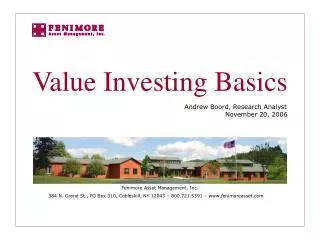
Value Investing Basics Andrew Boord, Research Analyst November 20, 2006 Fenimore Asset Management, Inc. 384 N. Grand St., PO Box 310, Cobleskill, NY 12043 – 800.721.5391 – www.fenimoreasset.com
Fenimore Asset Management, Inc. • Located in Cobleskill, NY • 32-year history of money management • $2 Billion of Assets Under Management • Separate accounts and two mutual funds • “Value” Investing in high-quality companies • About 50 - 60 investments among 4 analysts
What Is Value Investing? • Thoughtful, Disciplined and Patient • Preservation of Capital – First Priority • Invest in Businesses, Not Stocks • Bottom-up, Rigorous Fundamental Research
Investment Selection Criteria – Part 1 • High Quality Businesses • Understandable • Sustainable competitive advantage(s) – Moat • Solid Financial Condition • Low debt • Strong free cash flow:
Investment Selection Criteria – Part 2 • Superior Management • Honest and forthright • Understands return on invested capital • Strong track record of creating economic value (not building an empire) • Attractive Valuation • Reasonable multiple of “owner’s earnings” • Historical multiples of earnings, book value, sales, etc. • Acquisition multiples of competitors • Calculate an internal rate of return (min. of 12%-15%) based on 5-year projections and a modest terminal value
High Quality Business • First, Find Them • Screens • Conferences • Media • Other investors • Read, Read, Read • Study Competitors, Customers, Suppliers, etc. • Interview Management – Phone and Visits • Look at the Numbers – Build Detailed Models • ROIC • Margins • Cash generation
Superior Management • Hardest Piece of the Puzzle • Read, Read, Read – Shareholder letters & interviews • Quarterly Earnings Calls • Interact • Look for Independent Thinkers (a.k.a. Curmudgeons) • Cranky • Annoyed by Wall Street • Frugal • Don’t follow the herd • Avoid the Flashy • Spin all bad news • Play to Wall Street • Love consultants • Excessive pay
Financial Condition • Key is Surviving the “Once in a Lifetime” Economic Shocks • Asian crisis (ocean freighters) • Russian debt default and LTCM lock up (CMBS REIT’s) • Tech stock bubble meltdown (100’s of companies) • 2001 recession (airfreight carriers) • 9/11 (airlines, hotels) • Hurricane Katrina (catastrophe reinsurers) • No Debt is Safest • If There is Any Question, Then It is Not Strong Enough
Attractive Valuation • “Margin of Safety” • Patience – No Called Strikes • Should Be Cheap – No Matter the Valuation Method • Relative Valuations are Dangerous • Many tech stocks were cheaper than their peers in 1999 and lost 90%+ of their value • “Fearful When Others are Greedy and Greedy When Others are Fearful” • Usually cheap for a reason • Best when no one agrees with you • Best when your stomach hurts
What Is Risk? • Risk is Loosing Money • Dishonest management • Lack of disclosure • Commodity business (i.e., no moat) • Excessive debt • Overvalued stock • Risk is Not • Beta • Relative index weightings (a.k.a. “tracking error”) • Sticking out from the crowd
What We Don’t Do • Focus on the stock market • Make macroeconomic predictions • Structure portfolios relative to an index • Allow short-term company events to drive our actions • Sell a stock due to increased market capitalization, P/E, etc. • Use Wall Street recommendations • Apply quantitative modeling, momentum investing, or relative value techniques • Operate a star system
Other Keys • Macro-Based Investing is Dangerous • “Macro economists make astrologers look good” • “Invest as the world is, not as you think it should be” • Technical Analysis is Voodoo • Intelligence Important, but TEMPERAMENT is Key • Mr. Market • Transaction Costs • Accounting Does Not Always Equal Economic Reality • There is Always Something Wrong • Circle of Competence – You Don’t Have to Know Everything
The 7 Deadly Sins for Analysts • Arrogance • Cowardice • Sloth • Susceptibility to Flattery • Recklessness • Narrow-Mindedness • Isolophobia