Download
1 / 18
180 likes | 306 Vues
This lesson focuses on the analysis of absolute value functions, including determining their equations, intervals of increase and decrease, as well as their domain and range. We explore how absolute value equations relate to piecewise functions and how to effectively solve absolute value inequalities. Students will learn to set up and solve equations of the form ax + b = c, how to handle both positive and negative cases, and how to graph the solutions. Perfect for Math IIDay or any student needing a comprehensive understanding of absolute values.

E N D
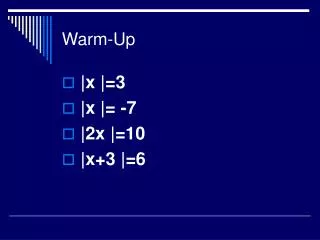
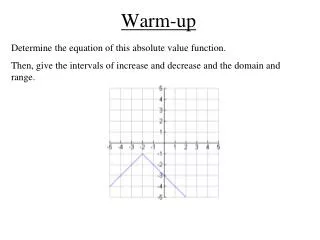
Warm-up Determine the equation of this absolute value function. Then, give the intervals of increase and decrease and the domain and range.
Math IIDay 40 (10-7-09) UNIT QUESTION: How are absolute value equations similar to piecewise functions? Standard: MM2A1 Today’s Question: How do we solve absolute value inequalities? Standard: MM2A1.b,c
2.2 Solving Absolute Value Equations & Inequalities p. 28-32
Absolute Value (of x) • Symbol lxl • The distance x is from 0 on the number line. • Always positive • Ex: l-3l=3 -4 -3 -2 -1 0 1 2
Ex: x = 5 • What are the possible values of x? x = 5 or x = -5
To solve an absolute value equation: ax+b = c, where c>0 (where c is positive) To solve, set up 2 new equations, then solve each equation. ax+b = c or ax+b = - c ** make sure the absolute value is by itself before you split to solve.
Ex: Solve 6x-3 = 15 6x-3 = 15 or 6x-3 = -15 6x = 18 or 6x = -12 x = 3 or x = -2 * Plug in answers to check your solutions!
Ex: Solve 2x + 7 -3 = 8 Get the abs. value part by itself first! 2x+7 = 11 Now split into 2 parts. 2x+7 = 11 or 2x+7 = -11 2x = 4 or 2x = -18 x = 2 or x = -9 Check the solutions.
To solve an absolute value inequality: ax+b < c or ax+b ≤ c, where c>0 To solve, set up a compound “and” inequality with –c and c and solve.
Ex: Solve & graph. • Becomes an “and” problem -3 7 8
To solve an absolute value inequality: ax+b > c or ax+b ≥ c, where c>0 To solve, set up a compound “or” inequality with -c and c and solve.
Solve & graph. • Get absolute value by itself first. • Becomes an “or” problem -2 3 4