
Fault Scenario Management: Node Trigger Actions and Message Handling in Networks
This document explores fault scenario management in network systems, focusing on the entry and trigger actions of nodes. It details how specific actions occur upon certain message triggers and the consequences of message loss and mutilation. We examine the migration of messages and data, logging actions for monitoring purposes, and handling memory mutilation. Additionally, we cover how to address memory content changes and document the process of migrating to specific nodes while ensuring data integrity.

Fault Scenario Management: Node Trigger Actions and Message Handling in Networks
E N D
Presentation Transcript
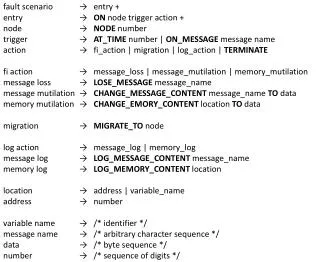
fault scenario → entry + entry → ON node trigger action + node → NODEnumber trigger → AT_TIMEnumber | ON_MESSAGEmessage name action → fi_action| migration | log_action| TERMINATE fiaction → message_loss| message_mutilation| memory_mutilation messageloss → LOSE_MESSAGE message_name messagemutilation → CHANGE_MESSAGE_CONTENTmessage_nameTOdata memory mutilation → CHANGE_EMORY_CONTENTlocation TO data migration → MIGRATE_TO node log action → message_log| memory_log message log → LOG_MESSAGE_CONTENTmessage_name memory log → LOG_MEMORY_CONTENTlocation location → address | variable_name address → number variable name → /* identifier */ message name → /* arbitrary character sequence */ data → /* bytesequence */ number → /* sequenceofdigits */