Effective Splinting Techniques for Musculoskeletal Injuries: A Comprehensive Overview
This resource provides an in-depth look at basic splinting techniques essential for the initial management of musculoskeletal injuries to the distal extremities. Splinting plays a crucial role in immobilizing injured limbs, reducing pain and bleeding, and facilitating the healing process. The document outlines indications for splinting various conditions, including fractures, dislocations, and sprains, with specific techniques for both upper and lower extremity injuries. Benefits, types of splints, and considerations for preventing complications are also discussed to enhance patient care.

Effective Splinting Techniques for Musculoskeletal Injuries: A Comprehensive Overview
E N D
Presentation Transcript
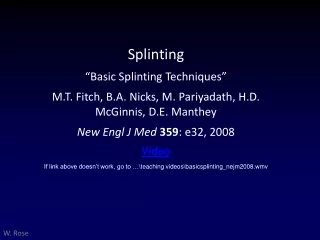
Splinting “Basic Splinting Techniques” M.T. Fitch, B.A. Nicks, M. Pariyadath, H.D. McGinnis, D.E. Manthey New Engl J Med359: e32, 2008 Video If link above doesn’t work, go to …\teaching videos\basicsplinting_nejm2008.wmv W. Rose
Indications & Benefits Splinting useful in initial management of musculoskeletal injuries to distal extremities. Splinting immobilizes injured extremities, prevents further injury, decreases pain and bleeding, allows healing to begin. Fractures: stabilization of an extremity fracture with a splint will preserve proper bone alignment and alleviate discomfort. Dislocations: After reduction of a dislocated joint, anatomical positioning is maintained by application of a splint. Sprains: Splinting may be used to maintain joint position and to alleviate pain for patients with ligamentous sprains. Fitch et al. (2008) NEJM 359: e32.
Upper Extremity Splints Volar splint: triquetral fracture, lunate dislocation, metacarpal head fracture Ulnar gutter splint: fractures of phalanges 4 & 5, metacarpals; flex MCP, PIP, DIP joints Thumb spica splint: fractures of scaphoid, lunate, first metacarpal, thumb Long-arm splint: fractures of proximal forearm, elbow; stabilize intraarticular fractures of distal humerus, olecranon; prevents elbow flex/ext & forearm pronation/supination Sugar tong splint: wrist & distal forearm fractures; prevents wrist flex/ext & forearm pronation/supination Fitch et al. (2008) NEJM 359: e32.
Lower Extremity Splints Posterior leg splint: severe sprains, reduced ankle dislocations, fractures of distal leg, ankle, & foot Posterior leg splint with stirrup: as above; also prevents ankle inversion/eversion Fitch et al. (2008) NEJM 359: e32.
Other terms; Questions Compartment syndrome Advantage of splinting over casting in the acute setting (soon after injury)? Fitch et al. (2008) NEJM 359: e32.