Older Population
140 likes | 257 Vues
As the aging population increases, women face unique health challenges dictated by socioeconomic roles, caregiving responsibilities, and biological distinctions. This leads to the feminization of poverty among older women who often live alone, earn lower median incomes, and encounter barriers to healthcare access. Issues such as over-medication, exclusion from research, and patriarchal tendencies in health services further exacerbate these disparities. Addressing these challenges requires a gender-based approach to healthcare that recognizes diverse experiences, promotes empowerment, and enables early access to comprehensive care.


Older Population
E N D
Presentation Transcript
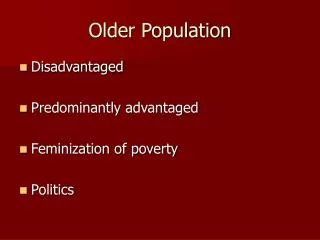
Older Population • Disadvantaged • Predominantly advantaged • Feminization of poverty • Politics
Determinants of Health • Gender • Biological distinction • Socioeconomic roles • Experience • Care giver • Barriers to health care • Live longer • Health care
MEN Life expectancy Health behaviors Alzheimer’s deaths Heart disease Suicide Fatal illness WOMEN Outnumber men Life expectancy Chronic conditions Live alone Lower median income Caretaking role Dependent Mental illness Gender Variations
Women and Health Care • Paternalism • Provider focus • Women’s concerns • Shared features • Mismatched focus
Inappropriate Health Care • Patronized • Discounted • Overmedicated • Information withheld • Treated unnecessarily • Focus on reproduction • Excluded from research
Health Care Industry • Reactive to proactive • Organ-centric to gender-based • early access to lifelong continuum
Women Centered Care • Gender differences • Reduce inequalities • Defining problems • Diversity • Empowerment • Women’s values • Holistic • Operationalize policies
Ethnicity and Aging • Immigration (1900’s) • 4% of seniors can’t speak English/French • 12% speak another language (home) • 3% aboriginal identity- aged 65+ • over 1 in 4 seniors is an immigrant • 11% immigrant seniors live with family • 6% of seniors – part of visible minority • by 2025 minority elders- 25% of aged pop.
Ethnicity • Social differentiation based on cultural criteria (concepts, habits, institutions) • Geographical origins • Language • Religion • Traditions • Values • Foods • Perceptions of distinctiveness • Internal heterogeneity
Leading Health Problems • High blood pressure • Coronary Heart Disease • Cancer • Diabetes • Cardiovascular Disease • Stroke • Cirrhosis • Trauma • Infection • Etiology
Ethnicity • Assimilation • Acculturation • Relocation in late life • Ethnocentrism
Barriers to Health Care • Communication (verbal/nonverbal) • Access • Fear • Health beliefs • Values • Socioeconomic status
Health Beliefs • Biomedical • Magico/religious • Naturalistic/holistic