Download
1 / 23
230 likes | 341 Vues
Saturn, the gas giant of our solar system, boasts 18 known moons and 2 unconfirmed satellites. The largest, Titan, is the second-largest moon in the solar system, characterized by a dense, nitrogen-rich atmosphere and surface lakes of liquid methane. Other notable moons include Mimas, known as the "Death Star" due to its cratered surface, and Enceladus, famous for its smooth ice and geysers. This overview delves into the fascinating features of these celestial bodies, from icy landscapes to dynamic atmospheres, highlighting their significance in our understanding of planetary science.

E N D
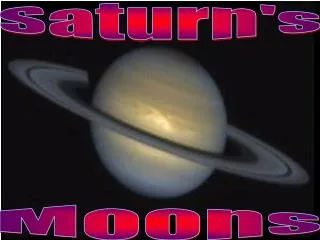
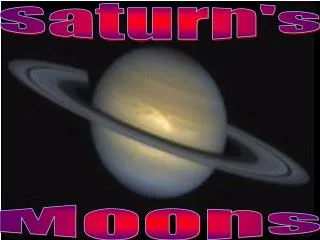
Saturn's Moons
About Saturn’s Moons • 18 known moons • 2 more unconfirmed • The largest moon is Titan
Titan • 2nd largest moon in solar system • It’s density is 2 g/cm3 • It’s made up of about half rock and half frozen water. • The atmospheres pressure is 1.5 times Earth’s • 90 to 99% of the gas is Nitrogen. The rest is methane and very small amounts of hydrogen cyanide and acetylene. • -180°:turns methane and other gases to liquid • Its orange because of that.
Mimas • Nicknamed the “The Death Star” • Creator is named Herschel • It’s so big that it’s gravity pulls material to keep it in a sphere • Named after a Titan the Hercules killed
Enceladus • Brightest object in Solar System except the Sun. • Something has erupted to make the planet so smooth (water, volcanic, etc…) • Named after a Titan that was killed by Athena
Tethys • Giant Ice cube • Was water at once. It just floated in the air until it froze • The moon Thetys was a named after a Titan sea goddess named Thetys
Rhea • 2nd largest moon of Saturn • 1/3 of the moon’s mass is rock. The rock is the core. The other 2/3 of the moon is ice. • Many creators cover the planet.
Hyperion • The largest non-ball shaped object in the solar system • Being that it isn’t round, scientist think that it broke off of a larger moon. • Named after the son of Earth and Uranus
Iapetus • Iapetus’ structure is primarily an ice ball. • Unlike most of the moons that orbit around the equator of Saturn, Iapetus orbits from top to bottom. • Named after the son of Uranus, that is said to be an ancestor to humans.
Phoebe • Phoebe is 4 times farther than Iapetus to Saturn • It’s darker tan a lot of Saturn’s moons • It orbits from top to bottom, and not around the equator • Scientists think that Phoebe is probably a comet or asteroid captured by Saturn’s Gravity.
Bibliography ~ Solar System • Origin of the Solar System." Pathlights. http://evolution-facts.org/. 17 May 2006 <http://www.pathlights.com/ce_encyclopedia/03-ss2.htm#Basic%20Theory>. • Spaulding, Nancy E., and Samuel N. Namowitz. Health Earth Science. Evanston, Illinois: McDougal Littell, 1999. 7-8.
Bibliography ~ Saturn’s Moons • "Debate 3: Where Did the Moon Come From? (Cont.)." Atropos.as.Arizona.Edu. 16 May 2006 <http://atropos.as.arizona.edu/aiz/teaching/a204/lecture15.html>. • Knight, David C. 32 Moons the Natural Satellites of Our Solar System. New York: William Morrow and Company, 1974. 57-72. • "Moons of Saturn." Kids Astronomy. 2006. 19 May 2006 <http://www.kidsastronomy.com/saturn/moons.htm>.
Bibliography ~ Saturn’s Moons • Seal, David. "Solar System Simulator." Nasa. First Gov. 18 May 2006 <http://space.jpl.nasa.gov/>. • Spaulding, Nancy E., and Samuel N. Namowitz. Health Earth Science. Evanston, Illinois: McDougal Littell, 1999. 422.