Auto-Anticoagulation and VTE Prophylaxis in Cirrhosis: Clinical Insights and Case Analysis
380 likes | 501 Vues
This presentation discusses the case of Mr. JE, a 33-year-old male with alcoholic liver cirrhosis who is at increased risk for venous thromboembolism (VTE) despite an elevated INR. It explores the pathophysiology of anticoagulation in cirrhosis, the clinical presentation of VTE risk factors, and evidence from recent studies. Recommendations for VTE prophylaxis are provided, focusing on the use of Dalteparin, along with monitoring strategies to ensure optimal patient outcomes. Key findings include the lack of protection from VTE with elevated INR levels.


Auto-Anticoagulation and VTE Prophylaxis in Cirrhosis: Clinical Insights and Case Analysis
E N D
Presentation Transcript
Auto Anti-coagulation and VTE Prophylaxis Hilary Rowe, BScPharm VIHA Pharmacy Resident 2009-10 Internal Medicine Rotation November 5th, 2009
Outline • Objectives • Patient Case • Background • Clinical Question • Review of Evidence • Recommendation • Monitoring
Objectives • Review pathophysiology for auto anti-coagulation & clinical presentation • Discuss evidence of auto anti-coagulation • Discuss therapeutic options for VTE prophylaxis
Mr. JE • ID: 33 yo Caucasian male, ht 170cm, wt 55kg • CC: ER by ambulance Sept 1/09 for weakness & falls-jaundice, ascites • HPI Oct 19/09: Small esophageal varices, ascites • PMHx: chronic lower back pain, alcohol abuse x 14 years
Mr. JE • Meds PTA: None • Allergies: None • SH: Homeless, estranged from family, smoker (30 pack yr hx), drinks 26 oz (780mL) vodka a day x 14 yrs • Discharge Plan: To family
Medical Problems List • Alcohol addiction • Alcoholic cirrhosis • Ascites • Esophageal varices • Anemia of chronic disease & iron deficiency anemia • Chronic lower back pain
DRP’s • JE is at increased risk of COPD, CVD and cancer secondary to smoking, requiring tobacco cessation counseling • JE has a mixed anemia secondary to iron deficiency and anemia of chronic disease, requiring monitoring of his anemia therapy
DRP’s • JE is at an increased risk of VTE requiring assessment of his need for DVT prophylaxis despite his elevated INR of 1.9
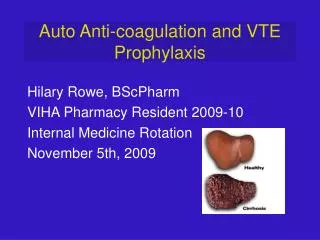
Alcoholic Liver Cirrhosis • Decrease in pro-coagulants • Can’t make II, VII, IX, X • Decrease in anti-coagulants • Can’t make Protein C, S & antithrombin III • PT & INR measures activity of pro-coagulants and doesn’t capture changes in anti-coagulants • PT does not predict bleeding risk
Risk Factors For VTE • Recent surgery or major trauma • Immobility or paralysis • Malignancy • Previous VTE • >80 years • Smoking • Varicose veins • Inherited or acquired thrombophilia
CTU Discussion Rounds • Team discussed that patient had been in hospital for a significant amount of time and might need VTE prophylaxis • Team wanted to know if his elevated INR of 1.9 would protect him?
Search Strategy • PubMed, Embase, Google • Search terms: • Liver cirrhosis • Risk of Thromboembolism • DVT, Pulmonary embolism • Auto anticoagulation • Found • 2 retrospective case control studies
Northup et al. Am J Gastroenterol 2006 • Lower albumin in patients with VTE • *38-53g/L normal, 1g/dL=10g/L • Elevated INR did not protect patients from VTE
Northup et al. Am J Gastroenterol 2006 • Results: • VTE in cirrhosis patients 113/21,000 (0.5%) • -74/113 (65.5%) DVT • -22/113 (19.5%) PE • -17/113 (15%) Both DVT & PE • -Serum albumin independently predicts VTE (p<0.001, OR 0.24 95% CI 0.10-0.55)
Northup et al. Am J Gastroenterol 2006 Conclusions • Deficiencies of antithrombin III, protein C & protein S are associated with ↑ risk of VTE • Serum albumin may be indicator for level of proteins made by liver such as Antithrombin III, protein C & S ↑ INR does not decrease risk of VTE
Sogaard et al. Am J Gastroenterol 2009 • Unprovoked VTE=patient without diagnosis of cancer before or within 90 days of VTE, or diagnosis of fracture, trauma, surgery, pregnancy 90 days before VTE • Each case matched with 5 population controls without a VTE by age, gender, county • Patients with several VTE’s had their first event used
Sogaard et al. Am J Gastroenterol 2009 Results • 20% (99,444/496,872) had a VTE • 22% (67,519/308,614) had unprovoked VTE
Sogaard et al. Am J Gastroenterol 2009 Limits • Retrospective • Relied on coding of Danish nationwide registry for diagnosis of VTE • No data on lifestyle factors • Declining risk of VTE in past 10 years • Is this due to prophylaxis?
Sogaard et al. Am J Gastroenterol 2009 Conclusion • Both cirrhotic and non-cirrhotic liver disease are risk factors for VTE
Goals of Therapy Patients Goals • Abstinent from alcohol Team Goals • Prevent VTE • Prevent hospitalization • Decrease morbidity & mortality • Minimize adverse drug events • Keep patient abstinent (quality of life) • Find housing (quality of life)
Therapeutic Options • No DVT prophylaxis • Sequential compression devices • Heparin 5000 units sc bid • Dalteparin 5000 units sc daily
Recommendation • Dalteparin 5000 units subcutaneous daily • Try to mobilize patient as soon as possible • Initiate smoking cessation counseling
summary Summary Question: Does elevated INR protect patient from a VTE? Answer: • ↑ INR does not decrease risk of VTE • ↓ albumin independently predicts VTE risk Future: • Study VTE prophylaxis in this population & predict benefit & risk of bleed
References • Northup PG, McMahon MM, Ruhl AP et al. Coagulopathy does not fully protect hospitalized cirrhosis patients from peripheral venous thromboebolism. Am J Gastroenterol 2006;101:1523-28. • Sogaard KK, Horvath-Puho E, Gronbaek H et al. Risk of venous thromboembolism in patients with liver disease: a nationwide population-based case-control study. Am J Gastroenterol 2009;104:96-101.