
Comprehensive Overview of Liver Functions, Structure, and Blood Supply by Dr. S. Chakradhar
This detailed document authored by Dr. S. Chakradhar explores the liver's anatomy, including its location, external features, and complex blood supply. It outlines the functionality of various hepatic structures, such as hepatic lobules and portal acini, and provides insights into liver functions like glucose metabolism, fat utilization, protein synthesis, bile production, and detoxification processes. Key roles of the liver in storing vitamins and minerals, along with its essential metabolic functions, are presented, emphasizing its importance in human health.

Comprehensive Overview of Liver Functions, Structure, and Blood Supply by Dr. S. Chakradhar
E N D
Presentation Transcript
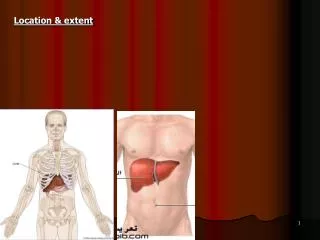
Location & extent Dr. S chakradhar
External Features Dr. S chakradhar
PortaHepatis Dr. S chakradhar
Hepatic Segments/Physiological lobes Dr. S chakradhar
Blood Supply • Hepatic artery • Portal vein carries nutrients from the stomach and intestine to the liver (also from spleen). Portal vein divides into fine branches- into sinusoids. Blood leaves sinusoids via hepatic vein to heart. Dr. S chakradhar
Histology • Hepatic lobules Dr. S chakradhar
Portal lobule: • This is the area of hepatic tissue between three adjacent central veins and centred on a portal canal with portal triads. • Is drawn by joining the central veins of the 3 adjacent liver lobules • Area supplied by portal traid Dr. S chakradhar
Portal acinus:/Liver Acinus • This is the area of hepatic tissue between the two adjacent central veins. This is metabolically the most active area. • Three zones are there: (i) Zone I (peri-portal) (ii) Zone II (intermediate) (iii) Zone III (near the central vein.) Dr. S chakradhar
Functions of Liver Dr. S chakradhar
Liver Functions Glucose metabolism • Important role in metabolism of glucose and regulation of blood glucose • Converts glucose to glycogen (storage) • Breaks down glycogen into glucose (energy) • Additional glucose is synthesized through gluconeogenesis (amino acids or lactate) Dr. S chakradhar
Fat Metabolism • Fatty acids broken down into ketones • Provide source of energy for muscles and other tissues • Occurs when glucose is limited as in starvation or uncontrolled diabetes • Fatty acids also used for synthesis of cholesterol, lipoproteins and other complex lipids Dr. S chakradhar
Protein metabolism In addition to synthetic function Protein catabolism & synthesis of urea formation Ammonia Conversion • Ammonia (potential toxin) is byproduct of gluconeogenesis • Liver converts ammonia into urea • Also removes ammonia produced by intestinal bacteria from portal blood • Urea is excreted in urine Dr. S chakradhar
Synthetic function Synthesizes all plasma proteins except gamma globulin • Albumin (osmotic pressure) • Alpha and beta globulins • Blood clotting factors • Specific transport proteins • Prothrombin: liver needs vitamin K Dr. S chakradhar
Bile Formation • Mainly water and electrolytes (potassium, calcium, bicarbonate, chloride) • Continuously made by hepatocytes and stored in gallbladder • Emptied into intestine when needed for digestion Bilirubin Excretion • Pigment derived from breakdown of hemoglobin • Modified by hepatocytes through conjugation to be more soluble in aqueous solutions • Conjugated bilirubin is carried by bile into duodenum for excretion Dr. S chakradhar
Vitamin and Iron Storage • Vitamins A, D stored in liver • Iron and copper Drug Metabolism • Liver metabolism generally results in loss of activity of the medication • Certain oral meds absorbed by GI tract may be metabolized by liver to such a great extent (first-pass effect) that bioavailability is decreased Dr. S chakradhar
