Strategies for Effective Process Scheduling in Operating Systems
This document outlines the various scheduling strategies employed in operating systems to manage process execution effectively. It distinguishes between long-term, medium-term, and short-term scheduling, each serving distinct purposes like process admission, swapping, and CPU dispatching. Key performance criteria such as response time, turnaround time, and throughput are discussed, along with user-oriented and system-oriented considerations. Various algorithms, including First-Come, First-Served (FCFS) and Round-Robin scheduling, are explored, highlighting their advantages, disadvantages, and the impact on system performance.

Strategies for Effective Process Scheduling in Operating Systems
E N D
Presentation Transcript
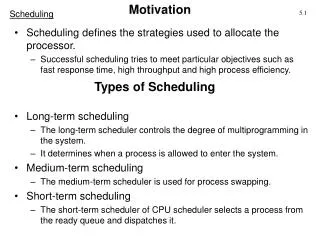
Motivation • Scheduling defines the strategies used to allocate the processor. • Successful scheduling tries to meet particular objectives such as fast response time, high throughput and high process efficiency. • Long-term scheduling • The long-term scheduler controls the degree of multiprogramming in the system. • It determines when a process is allowed to enter the system. • Medium-term scheduling • The medium-term scheduler is used for process swapping. • Short-term scheduling • The short-term scheduler of CPU scheduler selects a process from the ready queue and dispatches it. Types of Scheduling
Process State Transitionsand Scheduling New LTS Admit STS Dispatch Release Ready Running Exit Time-Out Event Wait Activate Event Occurs Suspended Blocked Suspend MTS LTS: Long Term Scheduling MTS: Medium Term Scheduling STS: Short Term Scheduling
Queuing Diagram for Scheduling Batch Jobs Time - Out Batch Queue Ready Queue STS LTS CPU Release Event Wait Interactive Users MTS MTS Ready, Suspend Queue Event Occurs Event Occurs MTS Blocked, Suspend Queue Blocked Queue
Scheduling Criteria • User Oriented, Performance-Related Criteria: • Response time • In an interactive system, this is the time interval between submission of the request (hitting the enter key) and the reception of some response. • Turnaround time • For batch jobs, this is the time interval between submission of a process and its completion. • Deadlines • When process deadlines are specified, execution of processes should be prioritized to increase the likelihood that deadlines will be met. • Especially important for some critical real-time systems. • User Oriented, Other Criteria: • Predictability • A job should run in about the same amount of time and at about the same cost independent of the load on the system.
Scheduling Criteria (cont.) • System Oriented, Performance-Related Criteria: • Throughput • Throughput is the number of processes completed per unit of time. • Since short response times may involve considerable context switching, high throughput may be somewhat compromised by short response times. • Processor utilization • This is the percentage of time that the processor is busy. • System Oriented, Other Criteria: • Fairness • Unless there is a priority mechanism in place, the system should give processes equal opportunities to secure resources including the processor itself. • In particular, no process should suffer starvation. • Enforcing priorities • The scheduling policy should favour processes with a higher priority. • Balancing resources • The scheduling policy should keep the resources of the system busy.
Process Priorities • Process priorities can be facilitated by using multiple ready queues. • The dispatcher will select processes from queue RQj only if queue RQi is empty (for all i<j). • To prevent starvation of processes in the lower priority queues, we can use an aging policy that allows a process to move up to a higher priority queue if it has not been dispatched for some predetermined length of time. Preemption RQ0 Dispatch CPU Release Event Wait RQ1 Multiple Ready Queues . . . Admit RQn Aging Blocked Queue Event Occurs
Priority Policies • An OS may have a policy that decides on the priority (i.e. which ready queue) is to be used for both newly admitted processes and processes returning to the ready queue. • This may depend on: • inherent priority of the process • predicted execution time • recent request for I/O • an aging policy.
Preemptive vs. Nonpreemptive • Nonpreemptive • If the process is in a running state, it stays in that state until it terminates or blocks itself to wait for an I/O completion or some OS service. • (NO time slicing!) • Preemptive • The currently running process may be interrupted and moved to the ready state by the OS. • Examples: - time slicing - SRT (to be described later) • We now consider various scheduling algorithms.
First-Come, First-Served Scheduling • Strategy: • As each process becomes ready, it joins the ready queue. • When the currently running process stops, the oldest process is next selected from the ready queue. • FCFS is nonpreemptive. • Pro: • FCFS is simple and has the least overhead. • Process starvation cannot occur. • Con: • FCFS tends to penalize short processes and I/O bound processes. • Since processes execute to completion CPU bound processes are favored over I/O bound processes. • Response times may be too long. • (bad for a multiprocessor environment) • Note: Despite the shortcomings, it is worthwhile to study FCFS as a starting point for other more sophisticated strategies.
Round-Robin Scheduling • A Preemptive Strategy: • A clock interrupt is generated at regular intervals to limit execution times • The interrupt defines a time slice for a process. • When the interrupt occurs, the currently running process is preempted (placed on the ready queue) and the next process to be dispatched is taken from the ready queue on a FCFS basis. • So: RR is essentially FCFS + time slicing. • RR involves more overhead (throughput is decreased) but the CPU is shared in a more equitable fashion. • The time quantum should be slightly greater than the time required for a “typical” transaction. • Note: fraction of time that process runs is q/(q+v) where v represents overhead time. • Pro: • RR is very effective in multi-user time-sharing environments and provides good response times for short processes. • Process starvation is not possible. • Con: • There is tendency to favor CPU bound processes over I/O bound processes • the latter miss out on full time slices since they frequently block to do I/O.
Virtual RR Scheduling • Strategy: • This is the same as RR except that an auxiliary queue is used to hold processes that have completed and I/O wait. • The auxilliary queue has a higher dispatch priority than the ready queue. • I/O bound processes now do better. Time-Out Ready Queue Admit Release Dispatch CPU Auxilliary Queue I/O 1 Occurs I/O 1 Wait I/O Queue 1 I/O 2 Occurs I/O 2 Wait I/O Queue 2 . . . I/O n Occurs I/O n Wait I/O Queue n
Shortest Process Next Scheduling • The SPN Strategy: • The process with the shortest expected process time is selected next. • SPN is nonpreemptive. • SPN approximates the idealized (optimal) strategy of dispatching the process with the smallest next CPU burst. • If this could be done it would give us the optimal strategy in providing the minimum average wait time. • SPN attempts to predict the length of the next CPU burst by working with previous behaviour. • A common approach is to use an exponential average:Sn+1 = aTn + (1-a)Sn where:Sn = predicted CPU burst for the nth dispatchTn = actual CPU burst for the nth dispatch. • Usually a may be chosen as 0.5 (perhaps a bit more). • A high value of a will quickly reflect a rapid change in CPU bursts. • Pro: • SPN provides high throughput and good response times for short processes. • Con: • Starvation is possible and there is no preemption.
Effect of SPN • Consider a ready queue containing three processes with next CPU bursts of: 12, 3, and 9. • Scenario A: • running the processes in a non-SPN order: 12 9 3Response times: 12 21 24Average Response Time = (12+21+24) / 3 = 19 • Scenario B: • running the processes in the SPN order: 3 9 12Response times: 3 12 24Average Response Time = (3+12+24) / 3 = 13
Shortest Remaining Time Scheduling(SRT) • Strategy: • The dispatcher chooses the process that has the shortest expected remaining CPU burst. • The preemptive version of SPN. • If a new process in the ready queue has a predicted CPU burst that is shorter than the currently running process the dispatcher will let it run by preempting the running process. • Overhead is somewhat higher than SPN but the benefits are worth the extra expense. • Pro: • SRT provides high throughput and good response times. • Con: • Process starvation is possible.
Highest Response Ratio Next Scheduling • A Non-preemptive Strategy: • In an attempt to minimize the normalized turnaround time (ratio of turnaround time to service time) we choose the ready process with the greatest response ratio RR = (w + s)/s. • Here w is the time spent waiting for the CPU and s is the expected service time (CPU burst). • By picking the largest RR we help to reduce w so that the average normalized turnaround time is also reduced. • As for SRT and SPN the service time s is evaluated by prediction using exponential averaging. • Note that “aged” processes (no CPU activity for a long time) will automatically get preference. • HRRN is a good blend of FCFS and SPN. • Pro: • Throughput is high and response time is good. • There is a good balance in the treatment of long and short processes • Process starvation is not possible. • Con: • Overhead can be high.
Multilevel Feedback Scheduling • Strategy: • Preemptive scheduling is done with a dynamic priority mechanism using multiple priority queues. • The idea is to automatically separate processes with different CPU-burst lengths. • A process starts at a particular queue level. • Each time a process is preempted by the end of a time slice it goes to a queue with a priority one level lower than the one just used. • Within each queue FCFS is used except for the lowest level queue which uses round-robin. • The effect is to penalize jobs that have longer CPU-bursts since short jobs complete before going into lower level queues. • Short burst processes (I/O bound and interactive) tend to stay in the higher queues. • The quantum duration may be longer for successively lower queues. • Does not depend on CPU burst prediction as does SPN, SRT, and HRRN.
Multilevel Feedback Scheduling (cont.) CPU Release Ready Queues: RQ0 Admit to RQ 1 Dispatch RQ1 to RQ 2 RQ2 to RQ 3 . . . . . . RQn from RQ n-1 via CPU Not Shown: paths leaving the CPU going to the wait event queues. After an event occurs, the process goes back to the same queue.
Multilevel Feedback Scheduling (cont.) • Pro: • Feedback provides a simple yet effective strategy. • It can be modified for various needs (see the NT approach later). • Con: • I/O-bound processes tend to be favoured and starvation is possible. • To avoid starvation we can promote older processes to a higher-priority queue. • Design aspects: • The multilevel feedback scheduling strategy covers a variety of different possibilities specified by the following parameters: • the number of queues • the scheduling algorithm used for each queue • the policy used to upgrade a process in order to avoid starvation • the policy used to determine the starting queue for a process having its first CPU burst. • the policy used for demotion in the queues.