Building Strength
This guide outlines essential strategies for developing strong programs that address community health disparities. It emphasizes the importance of identifying specific needs within populations and areas, assessing barriers to access, and aligning responses with budget plans. Key elements include a 1-to-1 match of needs and responses, built-in evaluation methods, and detailed budgeting for personnel, travel, and program expenses. By laying out a clear work plan and expected outcomes, organizations can effectively address issues while ensuring cost-effective solutions that create meaningful impact in underserved communities.

Building Strength
E N D
Presentation Transcript
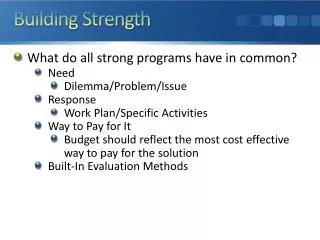
Building Strength • What do all strong programs have in common? • Need • Dilemma/Problem/Issue • Response • Work Plan/Specific Activities • Way to Pay for It • Budget should reflect the most cost effective way to pay for the solution • Built-In Evaluation Methods
Building Strong ProgramsProblem • Data is your friend • Doesn’t mean much unless you compare • Need can exist in a • Specific Population • Specific Area
Building Strong ProgramsUnderstanding the Need • Disparities • Means a group or an area is worse off than a comparable referent or than a set standard • Access Issues • Means there is a lack of services or staff • Barriers to Care • Means that a group or area can not, for some identifiable reason, access available care
Building Strong ProgramsResponse • Rule to live by: Everything is related!!! • 1 – to – 1 match between each need described and your proposed solution • Health Disparities Service Package • Access Problems Staffing Package • Barriers to Care Delivery Strategy
Building Strong ProgramsPaying for It • Rule to Live by: • 1 – to – 1 – to – 1 match from need through response to budget • Budget Areas - Expenses • Personnel • Fringe • Travel • Supplies • Program Expenses • Occupancy & Related Expenses • *even if you don’t need the money, put a $0 to show you have thought it through and won’t incur surprise costs
Building Strong ProgramsPaying for It • Rule to Live by: • 1 – to – 1 – to – 1 match from need through response to budget • Budget Areas - Income • This Request • Other Foundation/Corporate Grants • Government Grants • Individual Contributions • Earned & Interest Income • In-Kind Support • Other Income
Building Strong ProgramsExpected Outcomes/Impact • What will change about he situation as a result of your project? • Impact can be difficult to measure, but do the best you can to define your intentions. • Describe your outcomes & benchmarks, including what you will do if you don’t hit them. • Expect qualitative & quantitative outcomes.
Writing Strong ApplicationsNeed Statement • Paint the picture: describe the problem from a human interest & statistical perspective • Don’t forget the broader impact • Cite other work in the area
Writing Strong ApplicationsResponse • Be specific: What are you going to do? • Who will do each piece of the work? • When/where will the project take place? • You should be able to complete the following: • “The goals of this project are to [increase, decrease, or maintain] [activity or rate] (e.g., obesity, defined as 30% above recommended B.M.I.)among [population or area] (e.g., Spartanburg residents) by [solution] (e.g., providing obesity education).”
Writing Strong ApplicationsBudget • Give line-by-line explanation of costs • If there are other options for how to pay for something, show that you have weighed them • Narrate the budget in terms of the larger business plan
Writing Strong ApplicationsExpected Outcomes • Detail an outcome for each need and your proposed reponse • Write about your short and long-term outcomes. Now Midway Through End of Project Post-Project