Exploring Probability: Rolling Dice, Card Hands, and Arrangements
This comprehensive guide delves into various probability concepts, including the likelihood of rolling certain numbers on a die, arranging distinct items, and calculating probabilities from card decks. Topics cover practical scenarios, such as probability in coin tosses, arranging flowers, and selecting items from a group. Examples include calculating the chances of specific outcomes when tossing coins or selecting marbles, as well as understanding permutations and combinations in everyday situations. Ideal for students and enthusiasts eager to grasp the fundamentals of probability.
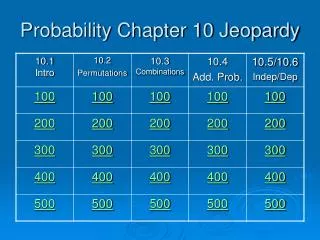

Exploring Probability: Rolling Dice, Card Hands, and Arrangements
E N D
Presentation Transcript
What is the probability of rolling a number lass than 3 on a single roll? 10.1 Intro- 100
A café’s lunch special offers 3 different appetizers, 4 different entrée’s and 5 different choices of soda. How many different choices are there for ordering one of each? 10.1 Intro- 200
How many 3 letter followed by 3 number passwords can there be if only odd numbers can be used? 10.1 Intro- 300
Find the probability of getting at least 2 heads in 3 tosses of a coin. 10.1 Intro- 400
Find the probability that a dart thrown at the dartboard will land in the circular region indicated if the side length of the square is 3. 10.1 Intro- 500
How many ways can 6 bunnies be place on a circular rack? 10.2 Permutations- 100
How many ways can you arrange 5 red, 2 blue, and 6 yellow tulips in a row? 10.2 Permutations- 200
How many different arrangements can be made from the word VALENTINE? 10.2 Permutations- 300
In how many ways can 3 males (Joe, Jerry, and John) and 3 females (Jamie, Jenny, and Jasmine) be seated in a row if the genders alternate down the row? 10.2 Permutations- 400
In how many ways can 5 seniors, 3 juniors, 4 sophomores, and 3 freshman be seated in a row if a senior must be seated at each end? Assume that the members of each class are distinct. 10.2 Permutations- 500
What are the formulas for 10.3 Combinations- 100
Evaluateand 10.3 Combinations- 200
Find the number of different 5 card hands that can be dealt from a 52 card deck? 10.3 Combinations- 300
Find the number of district committee’s that can be formed if 8 people are selected from a group of 12. 10.3 Combinations- 400
If 2 marbles are randomly taken from a bag of 5 white and 3 green marbles. What is the probability of drawing a white one and a green one? 10.3 Combinations- 500
Find the probability of rolling less than 5 or an odd number. 10.4 Using Addition with Probability- 100
Daily Double 10.4 Using Addition with Probability- 200
The numbers 1-8 are put into a hat. What is the probability of selecting the number 3 or 5? 10.4 Using Addition with Probability- 300
Find the probability that the spinner that is equally divided into numbers 1-8 will land on 3 or a number less than 4. 10.4 Using Addition with Probability- 400
Dad is at work. There are 40 people at work and 5 will be randomly picked for a drug test. What is the probability that dad will not get picked? 10.4 Using Addition with Probability- 500
A spinner that is labeled equally 1-8 and a coin are each spun and flipped respectively. What is the probability that the spin is a 4 and the toss is a tail? 10.5/10.6 Indepen. Depend. Events- 100
You flipped a coin 8 times and they will all heads. What is the probability that the next flip will be a head? 10.5/10.6 Indepen. Depend. Events- 200
Find the probability that a randomly selected child is 3 years old given that the child is a boy. 10.5/10.6 Indepen. Depend. Events- 300
Daily Double 10.5/10.6 Indepen. Depend. Events- 400
Without replacement, find the probability of drawing a blue first and a red second from a glass of 8 red, 9 yellow, and 5 blue m&m’s. 10.5/10.6 Indepen. Depend. Events- 500
Find the probability that the spinner that is equally divided into 1-8 will land on 4 or less than 6. Daily Double – -Wager points. -Only you get to answer.
For one roll of a number cube, let A be the event “even” and let B be the event “2”. Find the probability of P(B|A). Daily Double – -Wager points. -Only you get to answer.