Understanding Electromagnetic Induction and Its Applications in AC and DC Circuits
This text explores the fundamental principles of electromagnetic induction, focusing on how voltage and current are induced in a loop of wire moving through a magnetic field. It explains the factors governing the magnitude of induced voltage, including the number of wire loops, magnetic field strength, and the rate of cutting magnetic field lines. Additionally, it contrasts direct current (DC) and alternating current (AC), highlighting the behaviors of each and their applications in generators, transformers, and electrical distribution systems.


Understanding Electromagnetic Induction and Its Applications in AC and DC Circuits
E N D
Presentation Transcript
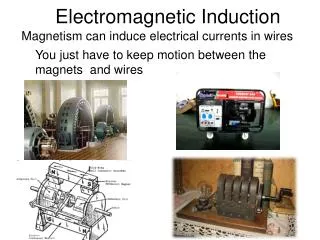
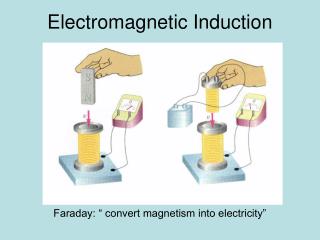
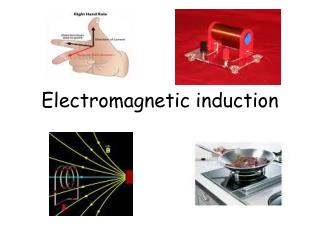
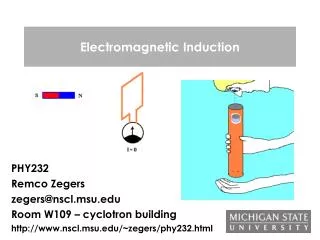
Induced Current: • Loop of wire -Moved in a magnetic field a voltage is induced in the wire. • Voltage = induced voltage + the resulting current = induced current. • Induction = Electromagnetic induction. Current is induced in a coil of wire moved through a magnetic field. Direction depends on the direction of motion.
The magnitude of the induced voltage is proportional to: • # of wire loops cutting across the magnetic field lines. • Strength of the magnetic field. • Rate at which magnetic field lines are cut by the wire. • Applications: • DC and AC Generators, • Transformers (step-up and step-down).
AC vs. DC Current • Direct current (DC)- The positive and negative terminals of a battery are always, respectively, positive and negative. • Current always flows in the same direction between the terminals. • Batteries, fuel cells and solar cells • Alternating current (AC)- The direction of the current reverses, or alternates, 60 times per second (in the U.S.) or 50 times per second (in Europe, for example). • Power that is available at a wall socket in the United States is 120-volt, 60-cycle AC power. • Power plant
Power companies convert alternating current to very high voltages for transmission then drop it back down to lower voltages for distribution inside the house for safety. • 1 million volts to1,000 volts and finally down to 120 volts • It's a lot harder to kill someone with 120 volts than with 1 million volts