Explain it
Explain it. Why your Research deserves good documentation and metadata. Question Mark Sign by Colin_K on flickr : http ://www.flickr.com/photos/colinkinner/2200500024 /. Why create documentation?. www.flickr.com/photos/smutjespickles/2434418686 /. Make material understandable.

Explain it
E N D
Presentation Transcript
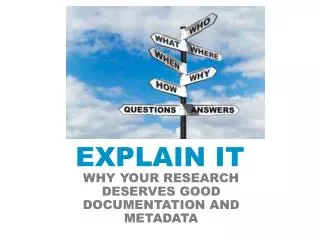
Explain it Why your Research deserves good documentation and metadata Question Mark Sign by Colin_K on flickr: http://www.flickr.com/photos/colinkinner/2200500024/
Why create documentation? www.flickr.com/photos/smutjespickles/2434418686/
Make material understandable Image: http://www.flickr.com/photos/archer10/5692813531/
Make material reproducible Image by woodleywonderworks on flickr: http://www.flickr.com/photos/wwworks/4588700881/
Documentation & Metadata • Metadata are: • Machine readable • Written according to standards “I guess it makes sense for a robot to read an e-book [401]” by brianjmatis on flickr
What to include (I) • Who created it, when and why • Include: • Description of the item • Method or theoretical approach • What is being measured • References to related data ? www.texample.net M. Farinelli et al. (2012) PLoSONE 7(3): e34047 description n. A set of characteristics by which something can be recognised By mdxdt on flickr: www.flickr.com/ photos/dxdt22/177749386/
What to include (II) • Define jargon, acronyms and code By Gavin Llewellyn http://www.flickr.com/photos/gavinjllewellyn/6826303487/ • Provide technicalinformation about the file • (may be generated automatically)
Explain it • Create documentation to make data: • Understandable • Reproducible • Re-usable • Findable (and searchable) • Explain: • Who created it, when and why • Methodologies and analysis techniques • Jargon, acronyms and code
Open Access Teaching Materials for Digital PreservationProduced by Anna Collins (2012) for the JISC-funded PrePARe project This work is licensed under a Creative Commons Attribution-NonCommercial-ShareAlike 2.0 UK: England & Wales License.