Understanding the Ambiguous Case in SSA Triangle Relationships
90 likes | 201 Vues
In triangle geometry, the ambiguous case occurs when you are given two sides and an angle opposite one of the sides (SSA). This situation can lead to one, two, or no possible triangles, depending on the specific values of the sides and angles involved. This overview will explore how to approach problems involving the SSA configuration, determining the number of solutions based on the relationships between the given angle and sides. Through examples, we illustrate the mathematical principles that govern these outcomes.


Understanding the Ambiguous Case in SSA Triangle Relationships
E N D
Presentation Transcript
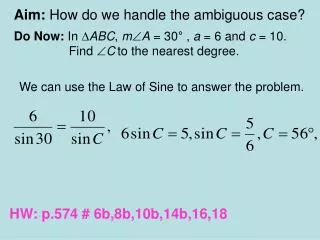
If we are given 2 sides and one angle opposite of one of the sides, we may not get just one answer. There are 3 possibilities … one answer, 2 answers or even no answer! The arrangement of the info is SSA Let’s think about this pictorially before trying out the math. For all these examples, we will consider being given m∠A, a, and b & we remember this was not allowed in geometry C a b A B c
C b a A B c ∠A could be acute… and a < b a b a b b a or a A A A 2 solutions if bsinA < a < b 1 solution if a = bsinA No solution if a < bsinA ∠A could be acute… and a ≥ b a b only 1 solution A
C b a A B c ∠A could be obtuse a a b b A A 1 solution if a > b No solution if a ≤ b
Ex 1) Determine the number of solutions. m∠A = 29°, b = 31, a = 23 m∠A is acute m∠A = 132° , b = 96, a = 105 a < b 23 < 31 so 2 solutions bsinA = 31sin29° = 15.02 < 23 < 31 a b m∠A is obtuse and a > b 105 > 96 a b A 1 solution
Ex 2) Solve △ABC if m∠A = 35.18°, c = 17.8 and a = 11.46 B 11.46 17.8 OR ??? 35.18° C A C and here? 180 – 63.49 = 116.51 116.51 + 35.18 = 151.69 < 180 Sure! m∠C = 116.51° Two Answers!
Ex 2) Solve △ABC if m∠A = 35.18°, c = 17.8 and a = 11.46 B 11.46 17.8 35.18° C A m∠C = 63.49° OR m∠C = 116.51° m∠B = 81.33° m∠B = 28.31° b = 19.66 b = 9.43
Ex 3) Solve △ABC if m∠A = 71.4°, a = 45.3 and b = 51.4 C 45.3 51.4 71.4° B A WAIT!! sin has to be between –1 & 1, so… No Triangle exists
Homework #503 Pg 261 #1, 5, 7, 15, 25, 29, 34, 35, 37