Download
1 / 6
60 likes | 206 Vues
The Fugitive Slave Act of 1850 authorized slave owners to reclaim escaped slaves in the North, even if they had been declared free. This law caused significant turmoil and conflict, as it undermined the rights of African Americans and incentivized judges to favor slave owners. Landmark cases like Prigg v. Pennsylvania highlighted the flaws in the system, as abolitionists like Frederick Douglass decried the injustice faced by escaped slaves. Explore the complexities of this era, key figures like Harriet Tubman, and the law's lasting implications on American society.

E N D
Fugitive Slave Act of 1850 By: Daniella Adarve and Stephen Blount
Fugitive Slave Act of 1793 • Slaves began fleeing to the North. • A law was put in place so that slave owners could reclaim their slaves even if they were free. • Prigg vs. Pensylvania • Many flaws
Free At Last? • Rights to the slaves • Judges were often givens bonuses as incentives to “return” slaves to their masters • If a fugitive was found they were to returned to their master. This caused some problems. “The colored men’s rights are less than those of a jackass” –Frederick Douglass
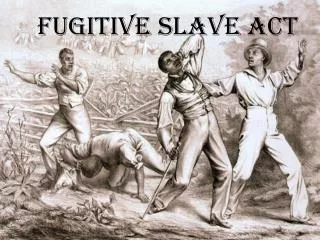
Fugitive Slave Act • http://www.civil-war.net/pages/fugitive_slave_act.asp http://formaementis.files.wordpress.com/2008/09/slave_kidnap_post_1851_boston.jpg
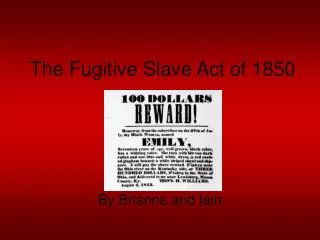
Who Did It? • Slaves fled • North vs. South • Harriet Tubman • South vs. North http://americanabolitionist.liberalarts.iupui.edu/reward2.jpg
Sources • (Danzer, 2003) Danzer, G. A. (2003). The americans. McDougall Littell. • ("The compromise of," ) compromise of 1850 and the fugitive slave act. (n.d.). Retrieved from http://www.pbs.org/wgbh/aia/part4/4p2951.html • ("Fugitive slave act," ) Fugitive slave act of 1793. (n.d.). Retrieved from http://www.answers.com/topic/fugitive-slave-act-of-1793