Understanding HBT and Hydrodynamic Models in Proton-AntiProton Collisions
This document reviews significant research related to proton-antiproton collisions, focusing on HBT (Hanbury Brown-Twiss) correlations and hydrodynamic models used for analysis. It references key studies and results from the E735 and OPAL collaborations, as well as the NA22 collaboration's investigation into the spatial and momentum anisotropies in high-energy collisions. The findings detail how blast-wave-type fits and the estimation of hydrodynamical parameters contribute to understanding particle interactions and flow characteristics in these high-energy physics contexts.

Understanding HBT and Hydrodynamic Models in Proton-AntiProton Collisions
E N D
Presentation Transcript
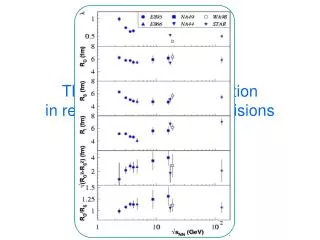
π+/p NA22 e+/e- AMY E735 UA1 OPAL HBT in pp collisions? Just a sampling • Dowell., Proc. Of the VII Topical Workshop on Proton-AntiProton Collider Physics, p115, Word Scientific 1989. • Lindsey. “Results from E735 at the Tevetron Proton-AntiProton Collider with root s= 1.8TeV”, Presented at the Quarkmatter 1991, Gatlinberg, Tennessee, Nov 11-15, 1991. • OPAL Collaboration. Physics Letters B. Vol 267 #1, 5 September, 1991. • NA22 Collaboration “Estimation of Hydrodynamical model parameters from the invariant spectrum and the Bose-Einstein Corrilations…”, Nijmegen preprint, HEN-405, Dec. 97. fm p/pbar
Centrality dependence of Rout/Rside 0.2<kT<2.0GeV/c , <kT>=0.46GeV/c
HBT dN/dt ~ 2 fm/c Blast-wave type fits 0~8-9 fm/c time F. Retière, QM04; F. Retière & MAL nucl-th/0312024 “BlastWave” fits • Hydro (blast wave) • Input Short emission time • Multiplicity • Flow • Hbt
Almond shape overlap region incoordinate space Pressure? “elliptic flow” barometer Origin:spatial anisotropy of the system when created, followed by multiple scattering of particles in the evolving system spatial anisotropy momentum anisotropy v2:2nd harmonic Fourier coefficient in azimuthal distribution of particles with respect to the reaction plane
STAR nucl-ex/0312009 Time From hbt From Glauber model