Exploring XDI and RDF: An Overview of Graph Structures and Relationships
30 likes | 145 Vues
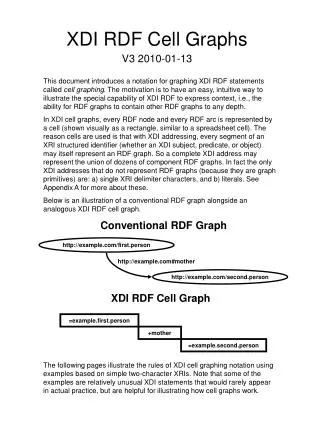
This document presents a detailed overview of XDI (XRI Data Interchange) and RDF (Resource Description Framework) graph structures, showcasing the relationships between various entities using compact statements. It features examples and interpretations of XDI/RDF statements, discussing the connections defined by the '$has' and '$is' predicates. The aim is to provide insights into the functional aspects of XDI and RDF graphing while illustrating how to represent complex relationships among data elements effectively. This resource serves as both an informative guide and a practical reference for those working with semantic web technologies.


Exploring XDI and RDF: An Overview of Graph Structures and Relationships
E N D
Presentation Transcript
XDI RDF Graphing V2 2008-12-19
Full XDI RDF statements (top)Compact statement (bottom) Standard RDFgraphs XDI RDFgraph 1 +x +x 2 (+x) +x (+x) 3 $has $has +x/$has/+y +x+y +x +y +x +y +x+y 4 $has +x+y/$has/+z +x/$has/+y+z +x+y+z $has $has +x+y +z +x +y +z $has +x+y+z +x +y+z 5 $has +x(+y)/$has/+z +x/$has/(+y)+z +x(+y)+z $has $has +x(+y) +z +x +y +z (+y) $has +x (+y)+z +x(+y)+z
Full XDI RDF statement (top)Compact statement (bottom) Standard RDFgraph XDI RDFgraph 6 +x/$has/(+y+z) +x(+y+z) $has $has $has +x (+y+z) +x +y +z +y+z (+y+z) +x(+y+z) 7 (+x+y)/$has/+z (+x+y)+z $has $has $has (+x+y) +z +x +y +z +x+y (+x+y) (+x+y)+z 8 $is +y +x/$is/+y +x +y +x 9 +x/$has$a/+y +x/+y $has$a +y +x +y +x 10 +y +x/+y/+z +x +z +x/+y/+z