Uniform Circular Motion in AP Physics
Learn about uniform circular motion, centripetal acceleration, tangential velocity, and more concepts in AP Physics. Explore examples and calculations to deepen your understanding.

Uniform Circular Motion in AP Physics
E N D
Presentation Transcript
Circular Motion AP Physics C Mrs. Coyle
Circular Motion • Uniform circular motion (constant centripetal acceleration) • Motion with a tangential and radial (centripetal)acceleration
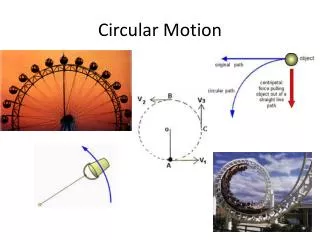
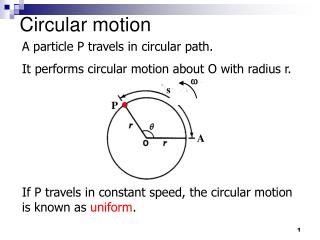
Uniform Circular Motion • Object has a circular path, constant speed. • The velocity is always tangent to the path of the object.
Why is there acceleration in uniform circular motion? Dv = vf– vi a= Dv/ Dt
Centripetal Acceleration • Vector • Always perpendicular to the path of the motion. • Points toward the center of the circle.
Characteristics of UniformCircular Motion • Tangential (linear) Velocity • Frequency • Period • Centripetal Acceleration
Frequency, f :#revolutions per unit time • f = # rev / time Units: • (1/sec)=sec-1=Hertz (Hz) • rpm (#rev/min) • rps (#rev/sec) r
Period • Period T : time for 1 revolution • Unit: sec, min, h • Relating Frequency and period f= 1 T
Tangential Speed in terms of T or f v=2pr/T v=2prf
Example 1 • A boy whirls a stone in a horizontal circle of r=1.5m, 2m above the ground. The string breaks and the stone strikes 10m away. What was the centripetal acceleration during the circular motion? • Answer: 160m/s2
Tangential Acceleration • When v varies. • Motion is not uniform circular motion.
Total Acceleration • Tangential acceleration (vector) Plus • Radial acceleration (vector)
Total Acceleration • Tangential acceleration: • Radial acceleration: • Total acceleration:
Total Acceleration • r, radius vector - q , tangent to the circle
Example 2 (#34) An automobile whose speed is increasing at a rate of 0.6m/s2 travels on a circular road of radius 20m. When the instantaneous speed of the car is 4m/s find: a)the tangential acceleration, b)the centripetal acceleration, c)the magnitude and direction of the total acceleration. Ans: a)0.6m/s2,b)0.8m/s2, c)1m/s2,53.1o