Download

1 / 8
80 likes | 199 Vues
The skeletal system plays a vital role in providing support, protecting organs, facilitating movement, and producing red blood cells. Joints, where bones meet, come in various types such as fixed, ball-and-socket, and hinge joints, each allowing different movements. Common bone injuries include sprains, fractures, and dislocations, while conditions like osteoporosis and scoliosis can affect bone health. To maintain strong bones, regular exercise, proper footwear, calcium and vitamin D-rich diets, good posture, and scoliosis screenings are essential.

E N D
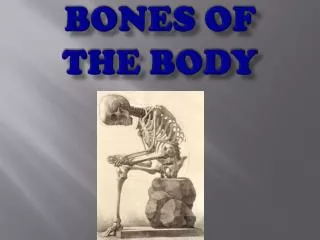
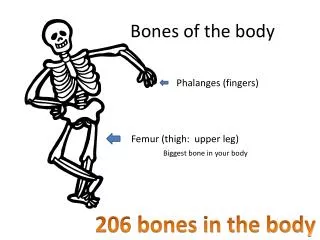
206 There are bones in our body
4 Functions of the Skeletal System are: 1- To provide support & framework for our body. 2 - To protect our organs. 3 - To help produce movement. 4. To produce RBC’s
What is a Joint? The point at which two bones meet. Femur Knee Joint Tibia & Fibula
Joints Fixed Joint - A joint that does not move. Can be found in your skull & pelvis
Ball & Socket Joint: A joint that allows movement in a full circle. They are in your hip & shoulder
Hinge Joint: A joint that allows bones to move back and forth. They are found in your elbows and knees
Bone Injuries & Diseases Sprain- an injury to the ligaments around a joint caused by over stretching. Fractures - A break or crack in a bone. The movement of a bone from the joint. Dislocations - Osteoporosis - A bone disease in which bone becomes thin. Scoliosis - A deformity of the spine in which the spine develops an S-shaped curve.
Ways to care for your 1. Exercise regularly. 2. Wear properly-fitting shoes. 3. Select food & beverages rich in calcium, & vitamin D(milk, egg yolks, leafy greens). 4. Sit, stand & walk with correct posture. 5. Participate in screening for scoliosis.