Download
1 / 10
100 likes | 210 Vues
In 1862, enslaved individuals in Virginia faced harsh laws prohibiting freedom and education while resistances manifested both peacefully and violently. They formed close-knit communities, supported one another, and preserved their traditions despite the dehumanizing slave codes. Spirituals expressed their beliefs and offered hope. Notable acts of resistance, such as Nat Turner's rebellion in 1831, highlighted the passionate struggle against oppression. John Brown's raid on Harper's Ferry in 1859 demonstrated the lengths to which individuals would go for freedom. Awareness of these struggles is crucial in understanding the legacy of slavery.

E N D
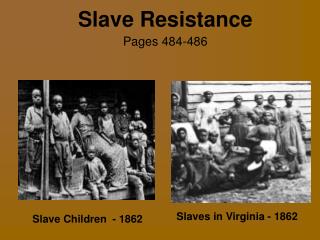
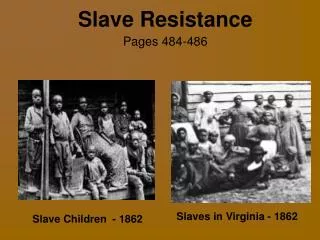
Pages 484-486 Slave Resistance Pages 484-486 Slaves in Virginia - 1862 Slave Children - 1862
Slave Codes • Most southern states had laws regarding slaves. • Slaves were not allowed to leave their owners’ land. • Slaves were not allowed to meet in groups. • Slaves could not buy or sell goods. • Slaves were not allowed to learn to read and write. • Slaves were treated as property.
Overseers • Overseers were hired to: • Watch over slaves as they worked • Punish slaves who fell behind • Punish slaves who disobeyed • Get more work from slaves • Buy and sell slaves
Slavery Survival • To help themselves survive: • Slaves formed close-kit communities. • Families, friends, and neighbors helped one another giving comfort and support. • They talked about what they remembered about Africa or what they had heard from others. • They tried to keep their traditions alive. • Religious beliefs gave many strength.
Spirituals • Slaves expressed their beliefs by singing spirituals. • Spirituals are religious songs based on Bible stories. • Swing Low, Sweet Chariot • Deep River • Go Down, Moses
Fighting Back • Most slaves did whatever they could to resist, or act against slavery. • They broke tools making the damage look like an accident. • They left gates open so that farm animals could escape. • They let boats drift away. • They hid household goods. • Some acted as if they didn’t understand what they were told.
Violent Resistance • In August 1831 in Virginia, a slave named Nat Turner led an attack that killed 57 people including his owner and the owner’s family. • Slave owners who were trying to stop the rebellion killed more than 100 slaves. • Nat Turner was caught, put on trial, and hanged.
John Brown and Harper’s Ferry • In 1859 John Brown, a white abolitionist, and a group of followers seized a government storehouse at Harper’s Ferry in what is now West Virginia. • The storehouse was filled with guns that John Brown planned to give to slaves so they could fight for their freedom. • John Brown was caught, put on trial, and hanged.