Download
1 / 64
640 likes | 769 Vues
This work presents a novel approach to real-time acquisition and rendering of dynamic scenes through image-based visual hulls. Building on previous methods such as Visual Hull and Volume Carving, our contributions include a view-dependent representation of visual hulls and efficient algorithms for sampling and computing visibility. The proposed system achieves robust and efficient computation, enabling real-time applications. This advancement is crucial for dynamic environments, enhancing interactive graphics and immersive experiences.

E N D
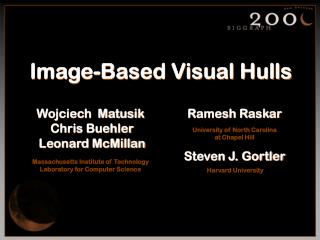
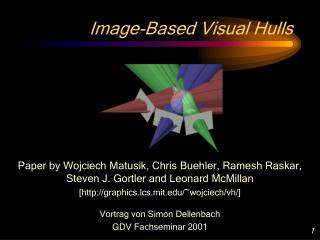
Image-Based Visual Hulls Wojciech Matusik Chris Buehler Leonard McMillanMassachusetts Institute of TechnologyLaboratory for Computer Science Ramesh Raskar University of North Carolinaat Chapel HillSteven J. GortlerHarvard University
Motivation Real-time acquisition and rendering of dynamic scenes
Previous Work • Virtualized Reality (Rander’97, Kanade’97, Narayanan’98) • Visual Hull (Laurentini’94) • Volume Carving (Potmesil’87, Szeliski’93, Seitz’97) • CSG Rendering (Goldfeather’86, Rappoport’97) • Image-Based Rendering (McMillan’95, Debevec’96, Debevec’98)
Contributions • View-dependent image-based visual hull representation • Efficient algorithm for sampling the visual hull • Efficient algorithm computing visibility • A real-time system
background + foreground background foreground - = Why use a Visual Hull? • Can be computed robustly • Can be computed efficiently
Rendering Visual Hulls Reference 2 Reference 1 Desired
Build then Sample Reference 2 Reference 1 Desired
Build then Sample Reference 2 Reference 1 Desired
Build then Sample Reference 2 Reference 1 Desired
Build then Sample Reference 2 Reference 1 Desired
Build then Sample Reference 2 Reference 1 Desired
Sample Directly Reference 2 Reference 1 Desired
Sample Directly Reference 2 Reference 1 Desired
Sample Directly Reference 2 Reference 1 Desired
Sample Directly Reference 2 Reference 1 Desired
Sample Directly Reference 2 Reference 1 Desired
Sample Directly Reference 2 Reference 1 Desired
Sample Directly Reference 2 Reference 1 Desired
Sample Directly Reference 2 Reference 1 Desired
Image-Based Computation Reference 1 Desired Reference 2
Observation • Incremental computation along scanlines Desired Reference
Binning • Sort silhouette edges into bins Epipole
Binning • Sort silhouette edges into bins Epipole
Binning • Sort silhouette edges into bins Bin 1 Epipole
Binning • Sort silhouette edges into bins Bin 1 Bin 2 Epipole
Binning • Sort silhouette edges into bins Bin 1 Bin 2 Epipole Bin 3
Binning • Sort silhouette edges into bins Bin 1 Bin 2 Epipole Bin 3 Bin 4
Binning • Sort silhouette edges into bins Bin 1 Bin 2 Epipole Bin 3 Bin 4 Bin 5
Binning • Sort silhouette edges into bins Bin 1 Bin 2 Epipole Bin 3 Bin 4 Bin 5
Scanning Bin 1 Epipole
Scanning Bin 2 Epipole
Scanning Bin 2 Epipole
Scanning Bin 2 Epipole
Scanning Epipole Bin 4
Scanning Epipole Bin 5
IBVH Results • Approximately constant computation per pixel per camera • Parallelizes • Consistent with input silhouettes
Shading Algorithm • A view-dependent strategy
Visibility in 2D Desired view Reference view
Visibility in 2D Front-most Points Desired view Reference view
Visibility in 2D Visible Desired view Reference view
Visibility in 2D Coverage Mask Desired view Reference view
Visibility in 2D Visible Coverage Mask Desired view Reference view
Visibility in 2D Visible Coverage Mask Desired view Reference view
Visibility in 2D Not Visible Coverage Mask Desired view Reference view
Visibility in 2D Coverage Mask Desired view Reference view
Visibility in 2D Visible Coverage Mask Desired view Reference view