
Abnormal Behavior: Criteria and Criticisms
E N D
Presentation Transcript
What Is Abnormality? Approaches to defining abnormal behavior • Does infrequency define abnormality? • Does suffering define abnormality? • Does strangeness define abnormality? • Does the behavior itself defines abnormality? • Should normality serve as a guide?
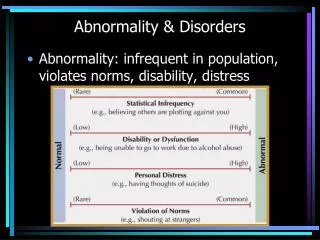
Suggested Criteria for Determining Abnormal Behavior • Statistical infrequency: • A matter of degree, a continuum. • The normal curve.
Criticism of Statistical Infrequency Criterion • Statistical definitions are relative to a particular time and place, therefore can change. • One can not apply statistical method to all extremes, there are limitations.
Suggested Criteria for Determining Abnormal Behavior • Social values/ morals: • Does behavior violate social norms? • Does the behavior make the observers anxious.
Limitations of Social Values and Morals Criterion • Some behaviors violate social norms but are tolerated and not considered abnormal (as in mental illness)
Suggested Criteria for Determining Abnormal Behavior • Distress/ suffering: • Does the behavior cause the person distress?
Limitations of Distress Criterion • What about behaviors that are distressing yet infrequent? • What if the person does not see his/her behavior as causing distress? • What if the person sees his/her behavior as distressing but not abnormal?
Suggested Criteria for Determining Abnormal Behavior • Disability or Behavioral dysfunction/ maladaptive: • What is the function of the behavior? • Utilitarianism: the greatest good for the greatest number. • Behavior is considered abnormal if it harms individual or society . • Less sever: considered abnormal if behavior inhibit someone from reaching full potential.
Criticism of Disability or Behavioral Dysfunction Maladaptive Criterion • Same behavior can be viewed differently depending on context • Some consider activities to be inherently wrong no matter if it is beneficial.
Suggested Criteria for Determining Abnormal Behavior • Unexpectedness: • Behavior is unexpected for the situation (similar to statistical infrequency).
Normal Behavior • Definition: Traits that indicate emotional well-being the normal person posses to a greater degree than the individual who is diagnosed as abnormal
Normal Behavior • Efficient perception of reality. • An ability to exercise voluntary control over behavior. • Self esteem and acceptance. • An ability to form affectionate relationships. • Productivity.