Accessory Dwelling Units (ADU)
250 likes | 268 Vues
Discover how Accessory Dwelling Units (ADUs) benefit communities, homeowners, and tenants, fostering sustainable growth and energy efficiency. Learn about ADU options, regulations, and affordable housing initiatives.


Accessory Dwelling Units (ADU)
E N D
Presentation Transcript
Accessory Dwelling Units (ADU) Smart Growth / Smart Energy Toolkit
What is an ADU? • An Accessory Dwelling Unit is a secondary housing unit on the same property as a main residence. • ADUs are also called accessory apartments, in-law apartments, family apartments, or secondary units. • ADUs are not duplexes : • Size of ADU is subsidiary to the main residence • Owner of ADU usually lives on the property • ADUs are self-contained
Why consider an ADU bylaw? • Shrinking household size • Rising real estate costs • Aging population • Neighborhood stability • Character of neighborhoods • Environmental benefits
What does it do for you? • Municipality: • Increases tax revenue • Minimizes subsidies required for affordable units • Maximizes use of existing infrastructure and services • Keeps growing and aging families together • Preserves of existing housing/historic structures • Promotes safer and stable neighborhoods
Who benefits from ADUs? • Homeowners – rental income • Middle-income tenants – more units • Local businesses – employee housing • Real estate firms – rental stock • Residential contractors – remodeling • Lending institutions – home improvement loans
Affordable ADUs • Local Initiative Program can be an instrument for affordability • ADU qualification conditions for MA Subsidized Housing Inventory (SHI) • Unit approved by local bylaw and DHCD • Unit occupied by income-eligible tenant (≤80% of area median income) • Unit rented at affordable price over term of control • For SHI details, contact Department of Housing and Community Development at www.mass.gov/dhcd
Who typically chooses to build ADUs? • Older singles/couples • Middle-aged "empty nesters" • Younger singles/couples • Single working parents • People who travel often
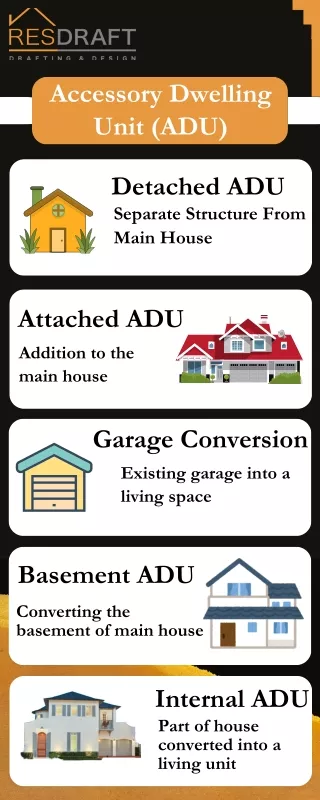
How and where are ADUs built? • Apartments in single-family homes • Additions to homes • Conversion of garages or barns • Free-standing cottages • Designed into new construction
ADUs and Neighborhood Type Traditional Neighborhood Blocks Features: • Shallow lots, with or without alley • Carriage houses and garages at the back of the lot • Original carriage houses small single bay buildings • ADUs sited along alley frontage or rear property line
ADUs and Neighborhood Type Transitional Neighborhood Blocks Features: • Pre-war grid blocks with pre- and post war housing • Deep lots • Garages located in rear yards • ADUs placed within garage zone in rear yards
ADUs and Neighborhood Type Suburban Neighborhood Blocks Features: • Cul-de-sac blocks • Small yards • Parking in front of lot with 20’ driveway parking • ADUs sited in rear lot areas on bigger lots and/or garage conversions
Regulation of ADUs • Zoning ordinance/bylaw • Specifies ADU conversion standards • As-of-Right • For interior alterations • Special Permit • For exterior changes and out buildings • Licensing • Periodic appraisal of ADU via renewal or for change in ownership
Issues relating to ADUs • Eligible tenants • Can be restricted to family members, low-income; or unrestricted • Maximum persons or bedrooms allowed • Varies between 1 to 2 bedrooms with up to 3 people • Homes eligible for ADU’s • Need for restricting ADU’s to certain percentage? • Permitting • Special Permit, Site Plan Review or by right
Issues relating to ADUs • Minimum lot size • Maximum interior floor space of ADU • Setback • Ingress/ Egress • Wastewater and stormwater management • Parking • Consider allowing waiver if transit is a reasonable option
Issues relating to ADUs • Recording at the Registry of Deeds/ Land Court • Can submit the document to the Building Commissioner prior to issuing an occupancy permit. • Annual compliance/ temporary status • No requirement for annual compliance/ renewal. Instead, use change in ownership as trigger for renewal of the ADU.
Launching an ADU program • Resident task force • Data gathering • Community support • Sponsoring organization • Education for homeowners
Summary of ADU Benefits • Creates new housing using existing infrastructure and services • Reduces energy consumption • Generates community dollars through home equity • Reduces costs for the elderly • Preserves housing stock and neighborhood stability
Selected MA communities with ADU bylaws • Case studies • Pelham, rural community • Lexington, suburban community • Northampton, urban community
Additional Information • MA Housing Partnership (MHP)http://www.mhp.net • MA Department of Housing and Community Development (DHCD)http://www.mass.gov/dhcd/ • Background on Subsidized Housing Inventoryhttp://www.mass.gov/dhcd • Older Americans Act websitewww.aoa.dhhs.gov
Additional Information • ‘Taking the Initiative – A Guidebook on Creating Local Affordable Housing Strategies’, CHAPA and MHP, Chapter 3, pp. 49-51 (March 2003)http://www.mhp.net/uploads/resources/taking_the_initiative_guidebook__ch._111.pdf • ‘Granny Flats Add Flexibility and Affordability’, New Urban News Ithaca, NY, New Urban Publications, (2001)http://www.newurbannews.com/accessory.html • ‘Accessory Apartments’, Leo L. Cram, Missouri Gerontology Institute, University of Missouri (1993)http://muextension.missouri.edu/explore/aging/gg0014.htm