Disentangling RB Pathway with BiNoM: Modeling Cell Cycle Regulation
330 likes | 352 Vues
Explore the RB pathway in cancer, its complexities, and key proteins involved. Use BiNoM with CellDesigner to analyze and model pathway interactions extracted from literature for deeper insights.


Disentangling RB Pathway with BiNoM: Modeling Cell Cycle Regulation
E N D
Presentation Transcript
Disentangling RB-pathway with BiNoM Laurence Calzone and Andrei Zinovyev Service Bioinformatique, Institut Curie, Paris 26/06/2007 MOCA IHP, Paris
Project on modeling regulation • of cell cycle by • RB/E2F Pathway • Travail de collaboration entre les équipes de : • - bioinformatique d’Emmanuel Barillot • - oncologie moléculaire de François Radvanyi 26/06/2007 MOCA IHP, Paris
CKI (p16) RB-P RB in tumor progression • RB is a cell proliferation regulator: RB is a tumor suppressor that controls cell cycle progression (G0/G1 and G1/S transitions). • The importance of the RB pathway is known in cancer: • RB is targeted and inactivated by viral oncoproteins (E7) • RB pathway is inactivated in most tumoral cells in different ways: - RB gene mutation - Deregulation of the kinases that control its activity Mitogenic Signal Cyc D CDK4/6 E7 RB E2F Progression of Cell Cycle 26/06/2007 MOCA IHP, Paris
CKI (p16) RB-P Construction of RB/E2F pathway from the literature Simplified view Mitogenic Signal Cyc D CDK4/6 E7 RB E2F Progression of Cell Cycle 26/06/2007 MOCA IHP, Paris
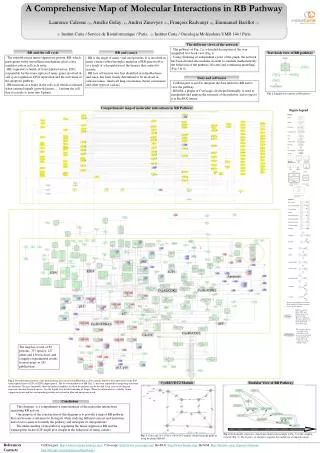
RB/E2F pathway: 78 proteins, 169 genes, 208 species, 166 reactions, more than 340 publications… 26/06/2007 MOCA IHP, Paris
Tools CellDesigner (SBML) to describe the interactions between proteins and organize the information extracted from the literature. BiNoM (Cytoscape plug-in) to manipulate the diagrams and query the network 26/06/2007 MOCA IHP, Paris
Comparing our pathway with other pathways METHOD : A subnetwork is extracted from the different databases (including only proteins present in our pathway) REACTOME Twice as many details in our pathway : - Species : 97 in REACTOME, 130 in our diagram - Reactions : 48 in REACTOME, 118 in our diagram - Entities (proteins or group of proteins) : 47 proteins in REACTOME, 74 in our diagram 36 complexes in REACTOME, 98 in our diagram • TRANSPATH - Species : 145 in TRANSPATH, 130 in our diagram - Reactions : 70 in TRANSPATH, 118 in our diagram - Entities (proteins or group of proteins) : 53 proteins in TRANSPATH, 74 in our diagram 28 complexes in TRANSPATH, 98 in our diagram 26/06/2007 MOCA IHP, Paris
Webpage + Publication 26/06/2007 MOCA IHP, Paris
Modeling the pathway Early G1 Late G1 S G2 M G0 26/06/2007 MOCA IHP, Paris
RB/E2F Pathway: paradoxes Learn with the model of the pathway • Loss of Rb with overexpression of p16 • Cf données transcriptome/génome • In the tumors of the bladder: gain/amplification of E2F3 observed with loss of Rb • Cf données transcriptome/génome • -E2F3 is involved as an oncogene but not E2F2 or E2F1 in bladder cancers • -Tumor suppressor and oncogene role of E2F1 Pierce et al., E2F1 has both oncogenic and tumor-suppressive properties in a transgenic model.Mol Cell Biol. 1999 • Sep;19(9):6408-14. • -Oncogenic transformation by Ras requires that RB gene is functionalWilliams et al.,The retinoblastoma protein is required for Ras-induced oncogenic transformation. Mol Cell Biol. 2006 Feb;26(4):1170-82. 26/06/2007 MOCA IHP, Paris
Dividing the pathway in modules • What to do? • Define the sub-networks (by hand and if possible automatically) • Isolate the sub-networks from the rest of the pathway • Establish the links between the different sub-networks • What for? • To read, understand and exploit the pathway • To improve the modules independently from the rest of the pathway • What next? • Modify the links according to the new proteins/genes/interactions added • Refine the subnetworks and model them • The more abstract view can be modeled and already answer questions, propose some predictive phenotypes 26/06/2007 MOCA IHP, Paris
Modular decomposition of the RB/E2F pathway • 16 modules: • RB • E2F Transcription Factors • Activator E2F1 • Repressor E2F4 • Repressor E2F6 • Cyclin-dependent kinases • CycC/CDK3 • CycH/CDK7 • CycD1/CDK4,6 • CycE1/CDK2 • CycA2/CDK2 • CycB1/CDC2 • Cyclin-dependent kinase Inhibitors • p16INK4a, p15INK4b • p21CIP1, p27KIP1 • Phosphorylation of cyclin B kinase • CDC25C • WEE1 • Degradation of cyclin • APC • Apoptosis entry Early G1 Late G1 S G2 M G0 26/06/2007 MOCA IHP, Paris
Some modules: RB RB module RB 26/06/2007 MOCA IHP, Paris
Some modules: E2F1 E2F1 Module E2F1 26/06/2007 MOCA IHP, Paris
Discrete modeling of the pathway( with Denis Thieffry ) 14 nodes (without apoptosis entry module) and influences of one major protein on the others Drawn and computed later in GinSIM (Thieffry) 26/06/2007 MOCA IHP, Paris
Project . • Biological Network Manager • Cytoscape plugin • BiNoM version 1 release date – 1 September 2007The project is open-sourcehttp://bioinfo.curie.fr/projects/binom 26/06/2007 MOCA IHP, Paris
Four BiNoM modules BiNoM Structure analysis BiNoM I/O BiNoM BioPAX Query BiNoM Utilities 26/06/2007 MOCA IHP, Paris
BiNoM I/O CellDesigner CellDesigner User manipulations in BiNoM using Cytoscape graphics BioPAX BioPAX SBML 26/06/2007 MOCA IHP, Paris
BiNoM I/O : Creating and editing BioPAX 26/06/2007 MOCA IHP, Paris
BiNoM I/O : BioPAX Hierarchical pathway structure (useful for MOCA) pathway ‘Pathway structure’ layer Pathway step 26/06/2007 MOCA IHP, Paris
Module depends on the question… (MOCA, 25/06/07) • Divisive (Holme et al, 2003) and agglomerative (Ma et al, 2004) hierarchical clustering based on the shortest path analysis • Eigenpathways (Barret et al, 2006) - Principal component analysis of extreme pathway sampling • Conservation laws (P-invariants) (what basis to chose?) • Exactly solvable modules: • Gorban, Radulescu (2007) “Dynamic and static limitation in multiscale reaction networks”Adv.Chem.Eng (In press and in Arxiv.org) • Radulescu, Zinovyev, Lilienbaum (2007) Model Reduction And Model Comparison For Nf·kb Signaling. Proceedings of FOSBE 2007. • 5) Monotonic modules, timescale separation, stratification of attractors… • Radulescu, Gorban, Vakulenko, Zinovyev. Hierarchies and modules in complex biological systems. Proceedings of ECCS’06, 2006. 26/06/2007 MOCA IHP, Paris
RB-pathway test caseStep 1: Importing CellDesigner File in BiNoM 26/06/2007 MOCA IHP, Paris
In- and Out- digraph layers Bow-tie network structure (Ma et al., 2003) Cyclic part (Strongly connected components) IN OUT Network Output Boundary Conditions IS 26/06/2007 MOCA IHP, Paris
RB-pathway test caseStep 2: Pruning reaction graph 26/06/2007 MOCA IHP, Paris
RB-pathway test caseStep 3: Strongly connected components (Tarjan’s algorithm) 26/06/2007 MOCA IHP, Paris
RB-pathway test caseStep 4: Representing modular structure 26/06/2007 MOCA IHP, Paris
Relevant cycles in chemical reaction networksP.Gleiss, P.Stadler, A.Wagner, D.Fell Adv. Complex Systems (2001) MCB1 MCB3 MCB2 Relevant cycles = union of minimum cyclic bases (MSC) It is unique minimumcyclic decomposition of a graph Vismara’s algorithmis able to deal with families of relevant cycles 26/06/2007 MOCA IHP, Paris
Cycles in reaction networks as functional unitscase 1: mass flow Cycle is an elementary mode (FBA) or T-invariant 26/06/2007 MOCA IHP, Paris
FBA-like path analysis can be also used (Klamt et al., 2006) Cycles in reaction networks as functional unitscase 2: “information” (perturbation) flow 26/06/2007 MOCA IHP, Paris
IN OUT RB-pathway test caseStep 5: Decomposition of Giant Strong Component 15 relevant cycles Agglomerative clustering number of reactions 5 cyclic modules with >50% node intersection Other nodes from IN and OUT part of the graph are connected to cyclic modules 26/06/2007 MOCA IHP, Paris
Modular decomposition 26/06/2007 MOCA IHP, Paris
Modular decomposition (RB-E2F1 module interface) 26/06/2007 MOCA IHP, Paris
What else? • Using semantic information ? • Being a bit more quantitative ? 26/06/2007 MOCA IHP, Paris